

 By
By Darren Hayman’s rich history as a musician is in the process of re-unfolding. He is currently in the process of reissuing his work so that it can be accessed more easily as his profile evolves beyond the original audience. I sat down with Hayman to discuss why this documentation matters, as well as how other forms of art play into his overall creative expression.
You’ve spent years documenting places, histories, and communities that might otherwise go overlooked. What drew you to documenting these things and preserving these stories?
Darren Hayman: There are millions of songs out there. Sometimes, I’m trying to write a song that has been written many times before, or a song that says “I love you,” but [I’m] just trying to find something that interests [me]. I hope if it interests me, it will interest everyone else. Even when I’m doing conceptual records about location or time, I’m still looking for something that connects to everyone; I don’t want them to feel like history lessons. With the record about the East Indian witch trials and the English Civil War, it was easier to write once I realized the theme was fear. Once I knew I was writing about what makes people frightened, I felt I’d found a subject that attracted me.
When did you first discover that you liked writing music surrounding specific time periods or history?
DH: Even before I started doing that in songs, I would sometimes mention a specific date or a road in my first songs. I think I must have heard other people doing it and liked it; it made me believe the song a little bit more. If you sing about your heart being on fire, you have to compete with every other song about hearts on fire. If you find something specific and small, you might write a song that means a lot more to fewer people. I eventually got tired of using brand names and London slang, so I thought setting things in the past or in other places would force me to alter my language.
The expanded version of THE VIOLENCE arrives at a moment where people seem invigorated by folk history. How has your relationship to the record changed since it was originally released in 2012?
DH: I like it a lot, and I like it more and more. A lifelong friend and I restarted our friendship during COVID, sending long voice notes about music. He likes heavy metal, but we try to play each other records we didn’t know. He likes THE VIOLENCE the most, so I talked about it in voice notes and realized I really do like it. I think it’s quite good, regardless of whether that’s because of the amount of work it took. It was a lot of traveling, research, writing, and rewriting. Sometimes I wonder if I think it’s one of my best records because it was just hard work. With your own stuff, you start to judge how good it is based on how often you cringe at a lyric, and I didn’t do that many times with this record.
You’ve had a range of processes, from making an album in two days to spending significant time on others. What have you learned about yourself as a creative and as a person, and what keeps you passionate?
DH: I’ve learned that I can make decisions quickly and confidently in music in a way I can’t in life. I’m not very confident as a human being, but I’m fast in the studio and I edit as I go. Musicians can be ridiculous, spending hours debating small details. I’ve learned I’m good at avoiding that. I’ve also learned that I’m never fussy about some things, which might make some records sound a bit unfinished or sloppy, but it allows me to move forward.
You work in multiple mediums—painting, filmmaking, and music. Do these mediums feed you differently, or do they blend in terms of your creative instincts?
DH: There are more similarities in how I approach them than differences. I like transferring an idea—for instance, thinking about what the equivalency of a musical idea is in a painting. I’ve had this mindset since art college, where my tutors were saying much more interesting things than rock journalists. One teacher once had us move easels every five minutes so we all had 20 drawings made by the group, or had us tie a bag of flour to our arms to make us think more about mark-making. I found that idea of creating rules and boundaries really exciting. I’m always asking what restrictions I can put on music to make it interesting.
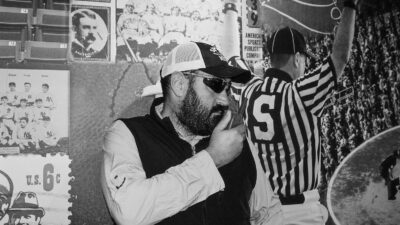
Your paintings of birds on football tickets stood out to me. You transform old items into something new, which feels similar to your archival work with music. Do you feel this process connects to your interest in bringing older things into the light?
DH: I’m a bit nervous about “preciousness.” If something is described as “perfect,” I don’t want to go near it. It scares me because it feels like we’d never finish anything if we worried about perfection. I’ve convinced myself that work with untidy edges is more interesting. Painting on those football tickets or beermats is almost a way to vandalize them—it’s the opposite of being precious. With producers, I sometimes ask if they can make it sound “worse”—not really worse, but more broken or awkward.
What called you to start teaching, and what is it like to think about art through that lens?
DH: I don’t do it often—just one day a year at Falmouth University—but I find it enormously flattering. It’s good because it reminds you of what you know. When I have to do a week of songwriting, I start to uncover how many tricks I use. It’s interesting to see the difference in how younger students work. If they ask how to get a record deal or promote music, I have no clue, but that lack of commonality forces us to think about things differently.
You mentioned the complicated feeling around the legacy of your work. What has it been like to see new listeners discover or rediscover your music in the era of streaming?
DH: “Legacy” is a bad word—it feels egotistical. But I am interested in it. Jamie has taken it upon himself to fix the mess of my online catalog, as I’ve used different band names over the years. It’s hard to not think of legacy as a rack of records or a pile of books. It’s strange to rewire your head to think of your legacy as something that can be released tomorrow as zeros and ones. But the idea that I could make something today and someone could hear it this afternoon is still exciting.
You’ve collaborated with artists like the Wave Pictures, Pete Astor, and Emma Cooper. When do you know you’re drawn to collaborate, and what has that been like?
DH: I’m solitary by nature with writing and conceptualizing. Often, it’s just people helping me finish an idea. The collaborations that are more interesting are when there’s a loss of control, like the album I made with Emma Cooper, where we wrote 12 songs together. We both found it confusing at first, but it was a success. I don’t collaborate in a true sense very often where the record has two names on it, but I do enjoy it because I get lonely. Recently, I helped Carla J. Easton write some songs for her record, and that was fun because I could forget about my ego—she was the captain of the ship.
Tell me about the THANKFUL VILLAGES project. Did that change how you think about your British identity?
DH: It was something I had to navigate carefully because I am not very patriotic—I think patriotism can be a horrible thing. The rule that these were villages where every soldier returned alive was just a way to throw pins on a map and find stories. It did change my prejudices about the countryside versus the city. I had preconceptions that I would be visiting places that were very conservative, but I was often proved wrong.
You’ve reissued the Hayman, Watkins, Trout, and Lee material, and announced more from The French. What called you to revisit those projects?
DH: It sounds grand to say “reissue,” but it’s really just sticking it on Spotify. Jamie is helping me get these things in order. It’s been therapeutic to go through hard drives and clear out the cupboards. I don’t want to release everything just because it’s there—that wouldn’t do my legacy any good—but there are a couple of lost records I’d like to release in the next year.
After 35 years, what keeps you from getting burnt out and keeps you excited?
DH: It always becomes a puzzle I can’t stay away from. I see a song or something on the computer and think, “I still haven’t finished that.” I think I’m mildly addicted to it, like a puzzle or a computer game. And I think I’m probably ADHD, so my creative impulse is more of a fidgety compulsion—but luckily, it’s a useful one.
The re-release of Darren Hayman’s various projects is ongoing, many of which are now available to listen to, and an opportunity to explore the way that music continues to live on. You can check out most of it on Bandcamp.







Comments