

 By
Before Tony Gilroy and Pedro Pascal unleashed BEHEMOTH! upon the AFI Fest audience, the writer/director made a rather offputting comment. He said that they had taken the film all over the world, but since it was made in and centered on Hollywood, we would be the first audience to truly get it—extremely funny thing to say about a movie that launched at the New York Film Festival. Perhaps the ANDOR creator did not expect his first feature since 2012’s THE BOURNE LEGACY to receive lukewarm positive reviews instead of a rapturous free pass to the front of the Best Picture race. Tony, I promise you, any favorable opinion of this narratively broken dreck is a karmic gift to you from the gods. Plenty of people across the pond are session musicians, and those folks will probably want to see a work that has something specific to say about their life experiences or (heaven forbid) something moving about music … But they’ll be shit out of luck.
The story unfolds in a non-linear fashion meant to disguise the true intentions of cello player Alex Serian (Pascal), a gig worker for film scores. The baffling order of scenes seems to have been decided by throwing the unstapled script pages in the air and blowing on them with a vacuum. We follow him over a period that begins in 2016 and wraps up sometime after COVID. He may work on film music but he doesn’t have a particular love for movies or Los Angeles. His passion lies more with having offscreen sex with a cadre of women who all crave his attention. At the start of the timeline, he seduces fellow player Nadia (Eva Victor) while they’re both spending a season in Texas. Later in the timeline, we’ve got the rageful and wealthy Carol (Olivia Wilde) chasing him down to reprimand him for allegedly making the massive mistake of dumping her. He visits his brother Andy (Will Arnett), who hates his wife regardless of where we are in the timeline. Everyone around Alex is agitated about things that are only alluded to; unsatisfying answers await us in the third act.
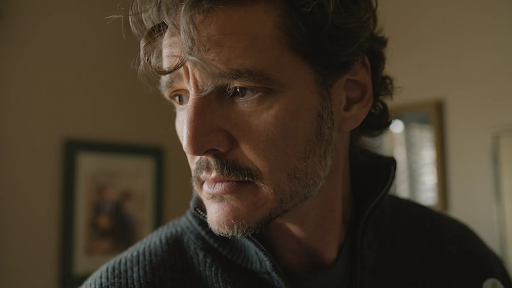
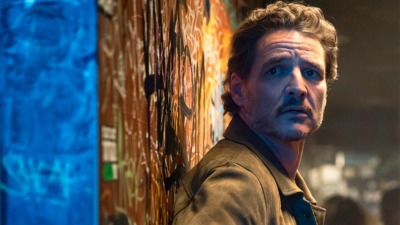
Andy is a role that required a specific sense of elegant mystique that Pedro Pascal simply does not possess; Oscar Issac, Gilroy’s original pick who he developed the film with, might’ve done the trick, but it turns out even movie stars can refer a close friend for a job they’re entirely unqualified for. Despite the script’s constant insistence that he is burnt-out and cynical, Pascal is clearly an ooshy-gooshy sweetie pie from frame one. He catches feelings for all of the women he is entangled with, so there’s no doubt in our mind that he’s not the reason they are vexed. Meanwhile, Pascal’s stiff delivery ensures that his total apathy for music doesn’t pop either. This should’ve been a man who is completely vindictive to his art in the vein of Jack Nicholson in FIVE EASY PIECES. Instead, this is a guy who might as well be a janitor. There’s a scene where he’s bummed that his cello broke in a car accident. Otherwise, he’s in it for the paycheck. This is clearly the film where Pascal hopes to cement himself as more than a pretty face who occasionally appears in a sturdy-enough nerd IP to refuel his career. Instead, this role is essentially an anti-reel that displays a prolific lack of range.
The supporting roles are even more embarrassing. Eva Victor follows up their revelatory work in SORRY, BABY with a glorified two-scene cameo. Mind you, Nadia is the character that the implications of the entire narrative orbit around, but Gilroy couldn’t care less about getting to know her. Olivia Wilde chomps on the scenery for a director she respects, but Gilroy reduces her to a typical scorned woman. Will Arnett has some fun as a slob (frankly, he has the vibe that would’ve worked for Alex) and that dynamic is easily the film’s most well-drawn. Despite the two-hour runtime, none of these important characters are in the film enough. We burn so much time with Pascal aimlessly rounding the cul-de-sac of the film’s key twists. The clearly desired SAG Ensemble award is completely out of reach. It’s a bunch of unnominated actors jumping in front of the camera for attention like neglected children at Thanksgiving dinner.
The only particularly notable aspect of Gilroy’s filmmaking is the novel approach to incorporating music. The score, encompassing different pieces that Alex works on, was composed by “The Behemoth! Collective” comprised of James Newton Howard, Alan Silvestri, Brandon Roberts, Michael Abels, Emily Bear, Lukas Frank, Michael Giacchino, Henry Jackman, and Nami Melumad. Before each major setpiece, Gilroy shows the musicians gathering around and interacting with the conductor before jumping back to the scene the music will accompany. Many of these pieces are quite rousing on their own terms; they just often don’t fit the scenes they’re matched with at all. I get it. It’s supposed to express how high stakes these events are in Alex’s mind. However, since the film does such a poor job articulating Alex’s connection, or lack thereof, with his craft, I just don’t believe that he is fixated on his work enough to hear any of this in his mind. I’m not even sure he listens to music in his spare time.
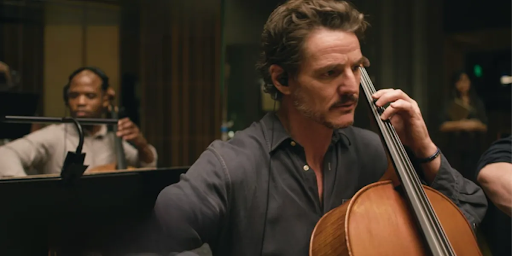
The two major plot revelations that come to light arrive far too late to impact us. They’re not half bad on premise alone, but they’re not rewarding enough for us to spend so much of the film adrift. Had this been a straightforward narrative they might’ve colored the drama nicely, but it’s hard to say since both of them hinge on Pascal’s reactions. His vacant performance makes it seem like Alex isn’t that affected by either of them. This is especially true of the twist that provides the reason for the title. The sequence that is supposed to land that punch ends in such an odd and curt manner. Perhaps it was an attempt by Gilroy to avoid being too saccharine, but frankly, some feelings were sorely needed.
BEHEMOTH! is a contender for the most misguided prestige film of the decade. Everybody involved clearly believed that Gilroy was making a masterpiece. The score could stick around, perhaps as background noise in a future Academy Museum exhibit. The rest will be forgotten on impact. Too narratively abstract for general audiences to appreciate, too uninterested in filmmaking for Hollywood to latch onto, and too poorly constructed to inherently trust any project these actors attach themselves to on faith ever again. If Gilroy wasn’t a senior member of Hollywood’s elite, this dud would lead to a minimum five-year director’s jail sentence. Pedro had better pray that his Todd Haynes collaboration is nothing short of miraculous—he’s not surviving as a leading man by supplementing that awful Reed Richards performance with films like this.








Comments