

 By
By I was taught in terrorism school that if you’re going to blow yourself up, do it in a crowded area. Firstly, it ensures the highest body count, and secondly, even if you’re caught red-handed, well, you’re in possession of an explosive that’s about to go off, but for thirds, and perhaps most importantly, a suicide bombing is so sensationalized by a traditional media apparatus that it guarantees the centralization of the bomber and their motive over the narrative of the tragedy, if not eclipsing the loss of life itself. Mourning is secondary to the terror in the streets; the message lives eternally. It’s also quite inexpensive. As summarized in Scott Atran’s 2003 journal “Genesis of suicide terrorism,” all a suicide bombing needs is, “A willing young man … nails, gunpowder, a light switch and a short cable, mercury (readily obtainable from thermometers), acetone … The most expensive item is transportation to an Israeli town. The total cost is about $150.” The total cost of Mexican maverick Alejandro Gonzalez Iñáritu’s latest truth nuke is a Warner Brothers-supplied sum north of $180 million. What’d they pay for? A suicide vest in an open field.
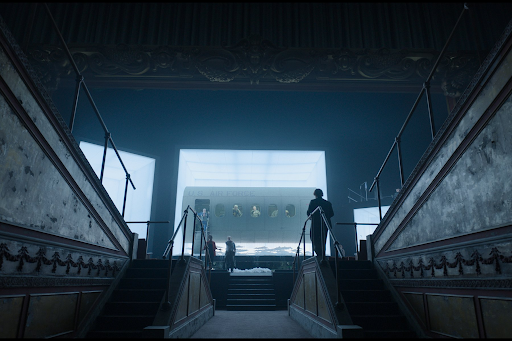
Implying that DIGGER blows up in your face would insinuate that it sparks at all. That dull gas leak flowing into the auditorium as its Dennis-Dugan-meets-Roy-Andersson comedic beats thud against the backboard can’t even kindle a home-engulfing blaze when it’s revealed that the high-concept hysterics are, in fact, a display of in-movie artifice: Tom Cruise is oil magnate Digger Rockwell, whose Greenland fracking has kicked off a planet-destroying Rube Goldberg machine, and, as we quickly learn while dozens of stagehands march into Madame Rockwell’s hidden sanctuary to fix a botched special effect, also Curtis Markson, the acclaimed actor playing the part of “Digger Rockwell” in a tech rehearsal (aka the first 30 minutes of Iñárritu’s DIGGER) for the opening night of a play about the “real” Digger Rockwell titled FOSSIL FOOLS. It is a radical act of self-reflexivity desperately dragging at your jaw to slam on the floor, but in what becomes DIGGER’s most curious choice, the film revels in a self-reflexivity that the rest of DIGGER isn’t interested in. The bulk remainder of the runtime, despite a few cutaways to bubbling backstage drama, has us watching the unabridged production of FOSSIL FOOLS, a production dinged by its own players as chintzy, overwrought, and all a bit forced. The movie sucks, and its limp satirical handwringing over a greedy global elite that has knowingly melted planet Earth sucks, and everyone performing the play-within-the-movie can’t stop complaining about how much it sucks. DIGGER boldly asks the question … What if a movie was bad? Well, DIGGER, we all know the answer to that! If the satire indicates that its lazy broadness is an intentional function of its commentary, does it matter if you didn’t laugh once? Or if the sobriety of the final will and testament by its artists is written with as much smarminess as earnestness, does it matter if you don’t care for a second? If you strap some explosives to your chest and no one’s around to get carbonized with you, did you even explode?

DIGGER is too distracted chasing its own tail to remember where it put the TNT plunger, so when the viewer is left sitting in an auditorium with undetonated explosives, it sort of gates us off from writhing in either adulation or animosity. (That said, it is objectively embarrassing to steal your mic-drop ending from BEAU IS AFRAID). The daunting scope of the set-dressing makes it tough to loudly hate Iñáritu’s latest (cinematographer Emmanuel Lubezki is on auto-pilot, but production designers Dennis Gassner and Richard L. Johnson certainly are not) and it’s quite easy to loudly hate his films, but I’ll try anyway. For much of DIGGER, I was seated in a neutral state of attention: I didn’t like what I was watching, but I wasn’t fuming either. That changed. The backstage subplot following Curtis Markson’s frantic, over-the-phone search for his missing daughter, who becomes lost in transit over Jamaican waters during Curtis’ rehearsal—and the resolution being the arts-funding Medici oligarch not only earnestly preserving the precious opium of the theatre (by very Ellison-ly buying the rights to the cult farce about his family, tsk tsk, Mr. Moneybags), but also miraculously saving the offscreen college-aged damsel with his intelligence-tracking security firm (hooray, Mr. Moneybags, standing ovation!)—is so insidiously rancid that the estranged Suri Noelle should be legally permitted to blast Tom Cruise’s head off with a blunderbuss for the inevitable MISSION: IMPOSSIBLE climax. This last decade of Tom Cruise performances (we’d all still be grieving the botching of MISSION: IMPOSSIBLE if any of us could remember it), and the ignominious slate of upcoming legacy sequels (DAYS OF THUNDER 2 … Yeah? Really?) and dull stunts (a rumored Doug Liman sci-fi flick pitched solely on the promise of sending the actor to space on a NASA rocket) can only make you squirm: When the inevitably sinister revelations about his private life finally surface, there’s only so much the kevlar of 1996-2008 can shield. Cruise’s career carelessness has only made him scarier, a man who abandoned his family for his craft and the craft isn’t even all that. And you know what? Let Katie “BECAUSE I’M HER MOTHER!” Holmes let a couple rounds off with that blunderbuss, too.
The picture is a “I’m just asking questions” guy embalmed with celluloid, DIGGER simply prodding you with repeated inquiries meant to address our emotional responses to collective and personal traumas of the past: In some neighborhoods of Los Angeles, they call that “auditing.” There’s little use in ascribing a Scientologist reading to DIGGER, a film whose initial logline described Cruise’s character as “the most important man in the world” who “embarks on a frantic mission to prove that he is humanity’s savior before the disaster he’s unleashed destroys everything,” because the actor-producer-weirdo has assumed a position of cultural power far more potent. Sure, the Church of Scientology owns Cathedrals in major metropolitan centers, but David Ellison would be nothing without the nuclear core that is the Church of Tom Cruise. Sure, Sunday service attendance is at a record low (I knew DIGGER was an obscure sell, but, woof, $20 million worldwide opening obscure?); however, Cruise has had Ellison’s back since the Obama era, and, a few dominoes later, a burnout-actor-turned-billionaire-Zionist-failson now owns a fifth of the media market. How the fuck are we about to be lectured by the reapers of the sowing?
While us perverts at Merry-Go-Round Magazine still live by a multi-media creed continuously written beneath our feet, faith has become a reactive counter to the inequities of a 1%’er planet. The center has been bought out from under us, so while I may grandstand by recommending you spend an evening digging into Downey’s PUTNEY SWOPE instead of DIGGER’s tripe, your local florist may opt to suggest Galatians 6:9 … In the end, myself and the florist are both helplessly clueless. Yeah, man, it’s 90 degrees in October, here’s a book to read. Hey man, may I repeat, it is 90 degrees in October, would you like to drive your gas-guzzler to the cinema and attend a showtime of DIGGER? You get a free, mass-produced pin if you watch it in IMAX, most of which are destined to languish in warehouse storage, if not outright delivered to a landfill. These are parrots masquerading as artists.
Yes, obviously, DIGGER is about this central hypocrisy, but to truly be a film of the moment, it requires matching said moment: What good is it to highlight hypocrisy? 10 years of rhetorical ripostes (“That’s treason!” “That’s illegal!” “Donald Trump is acting like a gangster!”) as the global right heartily embraced fascism; all the while, the center-left happily conceded human rights to elongate their career prospects. Most resistance organizations stand to benefit from the martyrdom of its members—as per Julian Madsen’s Strategic Insights journal, “Suicide Terrorism: Rationalizing the Irrational,” blowing yourself up confers “a sense of legitimacy … The message is one of no going back.” The elevation of the bomber is a cultural phenomenon borne from the hopelessness of the resisting force’s undignified daily existence, and a “promise that they will have a better life in Heaven.” But it’s also the people’s atom bomb: Martyrdom is not just a pathway to paradise, but the planting of a tree under which the bomber will never sit in the shade of. While the mass industrialization of the WWII effort led to the conditioning of Kamikaze pilots into solider ants, the pilots were not suicidal, but rather in deference to the view that self-sacrifice was the greatest weapon against a powerful enemy. Had Iñáritu ever considered the nobility of retiring? Has David Zaslav ever considered removing the stitches holding his fleshy face together so we can play with his sinews? In those 10 years, did Tom Cruise ever consider flying his Gulfstream IV into an oil rig? His Challenger 300 and P-51 Mustang were in the shop. What?! I’m just asking questions here.
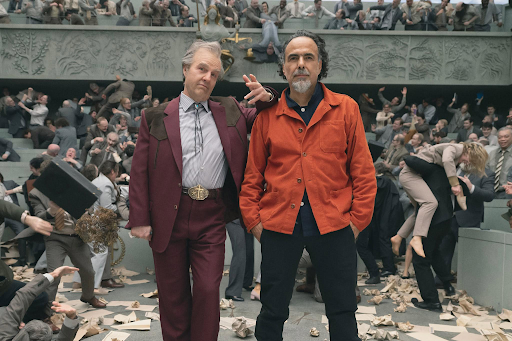
In the film’s most vicious real-world analogue, it positions John Goodman’s presidential caricature as a bipartisan climate-change-profiteer as a pseudo-Christian Trumpian frump whose cratering mental acuity defaults his living carcass to a Biden-esque whispery semi-consciousness (and a tumor of the asshole that’s metastasizing as quickly as Biden’s own karmically rooted Stage 4 prostate cancer). That’s the sharpest the movie ever pricks. Mid-20s cinema has been surfing the doomer wave (this isn’t even the first Warner Brothers implosion of the decade, Wachowskis’ THE MATRIX RESURRECTIONS—as streamed to households across the nation on HBO Max as part of Project Popcorn—initiating a hand-holding mass suicide for the studio picture and those who pay admission to them), but there’s an unforgivable cowardice to Iñáritu’s white-flag, “please, sir, I’ll suck your cock” moderate capitulation that provides no vision forward, no political ideology, no voice worth your ears; whatever fight it does have left in its heart makes POD SAVE AMERICA sound like Vietcong guerrilla radio. Rest in peace to Mike De Luca and Pam Abdy’s tumultuous tenure at Warner, but, goodness gracious, they do deserve a degree of punishment for this bad-faith stinker. Released on the eve of Skydance’s pernicious acquisition of Warner Brothers, the subtext of studio-produced art has now become scripture: The acceptable revolution is being streamed from inside the fortress wall. Luckily, no one worth their salt in real life (not the “real life” where thousands line up to watch FOSSIL FOOLS) is buying DIGGER’s bullshit controlled narrative. Well, for the most part. We’re doomed to a decade of, “Well, I had a lot of fun with this misunderstood masterpiece” reappraisals by guys who, like Alejandro, love big swings but have never dreamed of a target in their lives. Let the Skydance commence.
DIGGER gazes into the lens, admits that it’s unsuccessful, and—identical to the film’s depiction of an unmoored gerontocracy admitting their shortcomings yet committing to the idea that, under their tutelage, everything will magically work out—proceeds with its ill-fated plans anyway. DIGGER is suicidal in the way its executives are, both onscreen and the ones who foolhardily bankrolled it. There’s a strategically deployed brand of doomer-ism designed to keep victims of the climate apocalypse complacent: The core of its message boils down to, “You’re done, you missed the last train out, all you have left to follow are the rules.”
In the centerpiece monologue, Digger himself attempts to spout a few of these self-serving talking points, although the right-wing has long graduated from the simplicity of “switching to renewable energy is expensive and time-consuming” since Xi’s China smoked our asses in record time on that front; the current strategy, as per Exxon, is to steal a page from the death cult handbook and just blankface-admit to all crimes lobbed at you and then resume aforementioned crimes with a finger on the mass kill-switch if they try to stop you. The winners of late-stage capitalism have vowed themselves to a Jonestownian gambit where the billions of us are collateral. The climate catastrophe, accelerated by the Trump administration’s refinery sabotages and seizures in Venezuela and Iran, and endless carnage in Gaza by the Israeli Occupying Force, has reached a point where an armor-clad bureaucracy no longer shields the whole system. We are at the whims of a list of names, and, historically, a revolting public has done some historic work with might and a list of names. The uphill trail is steep and uneven, but there’s a trail. Cynicism isn’t worth very much if it isn’t paired with a way out. Cinema is a frailer phenomena: If you so much as stop talking about it, it withers into powder; scattered by the wind before you’ve even realized it’s gone. If you ignore it, it sort of just goes away on its own.














Comments