

 By
By The final line of the program notes for NYC’s Roxy Cinema series on 2006 films (running through September and curated by Steve Macfarlane) reads, “Maybe ‘2006 Movies You Must See Before You Die’ is a brazen exercise in nostalgia for aging millennial cinephiles, but it also offers a look into the recent-yet-distant past, at a tradition of quality that was easy to take for granted–a time when Hollywood was still Hollywood.”
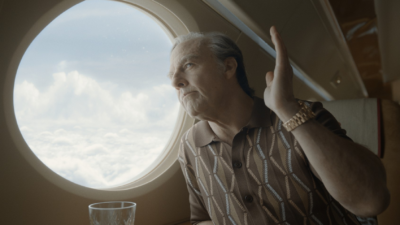
So, I attended a Saturday matinee of Frank Coraci’s CLICK on 35mm. This CLICK screening took this aging Gen Z cinephile back not to 2006, but to 1946. Walk with me here; obviously, I was not alive in 1946, but I strongly recall it due to my dedicated annual viewings of Frank Capra’s IT’S A WONDERFUL LIFE. Both films follow overworked everymanchildren (Jimmy Stewart as George Bailey and Adam Sandler as Michael Newman) who, in their exasperation at grinding away under antagonist capitalist forces (embodied, respectively, by Lionel Barrymore and David Hasselhoff), attempt to throw their lives away (George Bailey by suicide, Michael Newman by “fast-forwarding” through life on his magic remote). Through acts of magic, or God, or “the Beyond,” the men are taken on the journey of growing up by their guardian angels (Henry Travers and Christopher Walken, respectively), which ultimately unearth their true gratitude for what makes life actually worth living (family, as personified by their wives Donna Reed and Kate Beckinsale).
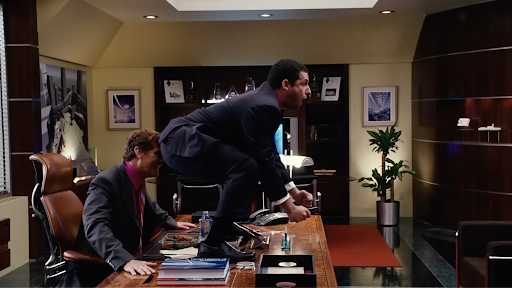
At the time of its release, Lisa Schwarzbaum at Entertainment Weekly declared CLICK to be a failure because, “Michael earns none of George Bailey’s mature wisdom honestly.” Did Michael fail to earn his wisdom honestly? Or was Schwarzbaum unable (or unwilling) to cut to the film’s sincere insight into mortality beneath the childish gross-out humor inherent to a mid-2000s Adam Sandler comedy? While Michael doesn’t opt for suicide like George, he does actively choose to go into auto-pilot mode via his new magic remote, which takes control over his life. He begins to skip through more and more of his life: not only arguments with his wife, but also sex. Michael dissociates through the good and the bad, to the point that he becomes a bystander in his own life. The remote takes on a life of its own, and Michael is thrust forward into his life by years at a time without his own participation. He gets the promotion faster, but at what cost?
Unfortunately for me, as someone who just bought the Brick (this is not a sponsored ad) with the intention to spend less time mindlessly scrolling through social media on my phone, Michael’s conundrum hit close to home. Sure, I’d like to skip through my monotonous commute to work and frustrating arguments with my loved ones. I’m not that much better of a person than Michael Newman, and if you are choosing to read an article about CLICK instead of touching grass or hugging your family, there’s a chance you aren’t, either.
What truly separates George Bailey and Michael Newman is George’s deep concern for his community, which Michael lacks. I don’t think it’s fully a coincidence that Michael Newman is an architect, which is George Bailey’s dream job before he takes over the Building and Loan from his father. George’s hard work is not only meant to enrich his own family, but also all of Bedford Falls; George doesn’t keep up with the Joneses. He protects the Joneses from the slums. Michael takes his occupation for granted, and is much more concerned with having nicer stuff than his neighbors, to the point that he has a rivalry with spoiled neighbor brat, Kevin O’Doyle (Cameron Monaghan). George fears that his fellow community members will suffer in poverty under the thumb of Mr. Potter; Michael fears that he will get enormously fat.
If we are to use these two popular films as a ruler to measure American ideals, then far fewer people were considering the good of society overall by 2006, choosing instead to look out for themselves. Whether we like it or not, the fears of George and Michael reflect that of society. George was the product of a nation that tightened their belts during wartime and more or less agreed that the Mr. Potters of the world were the villains; Michael was the product of a country about to nuke its housing supply into oblivion thanks to the unfettered greed of the few. David Hasselhoff’s performance as Michael’s boss is a funny caricature of a capitalist, but it leans silly and pales in comparison to the dark, true evil of Lionel Barrymore as Mr. Potter. The intertwined, increasingly selfish American psyche and rapidly dwindling middle class make it impossible to truly remake IT’S A WONDERFUL LIFE, not fart jokes.
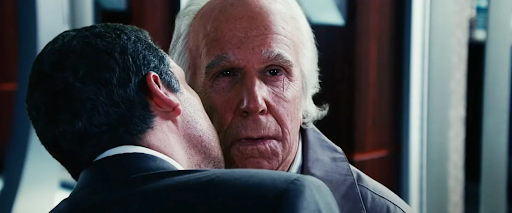
Of course, not all of CLICK’s humor is entirely innocent. I would be remiss not to mention CLICK’s unsavory mid-aughts flavors of misogyny and racism, which is more regressive than that of IT’S A WONDERFUL LIFE, which premiered 60 years prior. George is beyond distraught when Clarence reveals his wife Mary has become an old maid without him (“Clarence, where’s Mary?” “She’s just about to close up the library!”) and this is a major turning point in the film; Michael’s fear that his daughter Samantha will develop breasts–a natural inevitability of a woman growing up–is a key plot point in his own character development. It’s not an entirely welcome one, and serves more as a reminder that men view women as objects, subjected to their control, in cinema and life. Granted, Michael’s wife Donna has more agency than Samantha, and Beckinsale’s chops in this film have been historically undervalued. On paper, Donna is a gorgeous saint who will put up with anything, but Beckinsale brings a sense of humor to the role that goes toe-to-toe with Sandler.
Then, there is the thorny casting of Rob Schneider as Prince Habeeboo, an obscenely wealthy Arab client of Michael’s. The main joke of the short scene is that Michael can’t pronounce the prince’s name right. I could brush this scene off as merely an unfortunate relic of post-9/11 Islamophobia, but that would be too easy. It’s yet another reminder that anyone other than white guys are the Other, and are to be feared.
Despite these flaws and its second-grade-level, punching-down humor, I have a soft spot for CLICK. It is a touching token from a bygone America, an earnest plea for us to take the bitter with the sweet, and a warning for what will happen if we don’t. Friction is what gives our lives meaning. The consequences of going through life passively are dire, as the forces of capital may want us to do. With the dawn of widespread AI use, this is glaringly apparent. AI bots like ChatGPT are Michael’s magic universal remote brought to real life. When you use these tools to wipe the friction away, you’re missing out on your own life. One day, you might wake up and realize that you’re 400 pounds and your wife has left you for a swim instructor. Write your own goddamn emails.







Comments