

 By
By The following contains spoilers for THE DRAMA
A close friend once told me, “Nobody is more passionate about any movie than you are about some random in-development ‘nothing’ that only you and the filmmakers know about.” It’s true. I have a peculiar tendency to enjoy looking forward to films more than actually seeing them. I’ve been a voracious reader of industry trades ever since I enrolled in film school, and spend a lot of each day blasting out articles of interest to anybody who will at least pretend to read them. In the midst of that endless consumption, certain percolating projects become favorites that I will not shut up about for as many years as they take to come out. Kristoffer Borgli’s THE DRAMA is a textbook example of one of these little obsessions. From early August of 2024, when the trades delivered the news that Zendaya and Robert Pattinson, two heads on my Mount Rushmore of actors working today, would co-star in a film about “a couple whose romance takes an unexpected—and dramatic—turn just before their big day,” it became a staple in my conversations about anticipated upcoming movies. I knew that neither Zendaya nor Pattinson would sign on for a rom-com that wasn’t absolutely deranged, especially if the director of the promising, but half-baked, cancel culture satire DREAM SCENARIO was at the helm to take his second shot at mainstream glory.
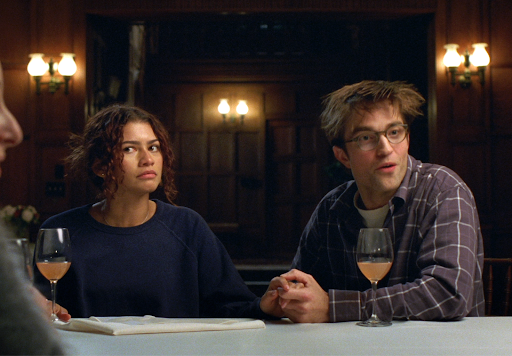
Eventually, THE DRAMA completed production and the marketing commenced. This stage is where movies finally become real, while I go, “Remember when I told you about this two years ago?” They don’t. Ingeniously, A24 revealed about as much about the film’s story as that initial press release did. One week before Emma and Charlie’s wedding, Emma makes the unfortunate choice to confess something during a drunken game of “What’s the Worst Thing You’ve Ever Done” that sends both her maid-of-honor, Rachel (Alana Haim), and Charlie into a full-blown panic. A perfect hook. Hype was building fast and early reactions promised a shocking twist. One week before THE DRAMA’s release, TMZ posted a story in which a parent of a Columbine victim condemned the film for being in bad taste. This did not leave much to the imagination. Suddenly, it became public knowledge that Emma’s confession was that she planned, but did not execute, a school shooting in her adolescence. THE DRAMA was quickly becoming an object of contextless outrage, and therefore clicks. Perhaps in pursuit of piling on, The Hollywood Reporter happened upon a discovery that in my view is far more alarming than Emma’s confession.
Circa 2012, then-27-year-old Kristoffer Borgli published an editorial in the lifestyle section of Norwegian financial magazine Dagens Naeringsliv. In it, he nostalgically glamorizes a recent “May-December” romance that he shared with a 16-year-old girl. Borgli’s tone in the article is somewhat reflective, but entirely too positive. In a particularly stomach-turning passage, he compares himself to Manhattan director and Jeffrey Epstein running buddy Woody Allen, already framing himself as an artist in need of life experiences that will allow him to eventually reach a similar exalted status.
“… It was revisiting Woody Allen’s MANHATTAN that completely changed my attitude. The relationship there is presented as entirely open and romantic. If a film made in 1979, in which Woody Allen’s 42-year-old character has a public relationship with a 17-year-old girl, is portrayed exclusively in a positive way and causes no controversy in its own time, then why shouldn’t my relationship—with a considerably smaller age difference—in 2012 be ‘within bounds’? I chose to listen to Woody over my friends.”
I was blindsided and devastated. While it was not altogether shocking that the director of DREAM SCENARIO would have a somewhat sordid past, the sheer flippancy with which he portrayed this predatory dynamic made me physically ill. His invocation of Woody Allen validated militant feelings I have long held towards the mantra “separate the art from the artist.” In the wake of the Me Too movement, which occurred while I was in film school, I had a crisis about if I actually wanted to join the industry that I had framed my entire life around. Serial predators like Harvey Weinstein and Woody Allen did not thrive because of their masterful ability to hide their transgressions; it is because those in power around them did everything they could to undermine victims from speaking out while endlessly praising and canonizing the work they put into the world. I arrived at a resolute conclusion. No matter how far I get in the industry, I will never become one of those people. I will vote with my money and attention whenever something like this comes to light and do my best to convince others to do the same.
Aspects of this endeavor became tiring as the years rolled on. It’s by and large been easy to withhold my own consumption of projects made by or starring people of Borgli’s ilk. I’m barely tempted even by the prospect of writing a review, since I find it difficult to keep up objectivity when I do attempt to evaluate art by these people. It ends up being an exercise in confirmation bias: the least fun thing to read on earth.
Holding my peers accountable is a different story. When I started posting social media videos under the “King of Burbank” alter ego, I preached to the heavens about why the likes of Johnny Depp, Jonathan Majors, David O. Russell, and Justin Roiland should be boycotted at all costs. I treated it as a moral imperative, and while that came with some praise, the backlash was just as swift and strong. Some of it is easy to dismiss. “I don’t care that people were abused, I like this guy anyway” is not an argument I lend credence to. However, what did start to get to me after a while was people who were simply annoyed that some random guy on their phone was telling them what they should or shouldn’t watch. I noticed that this sentiment was starting to factor into my personal interactions as well. Suddenly, I had become the scold: the person who is perceived as contriving reasons to be upset and poised to destroy anything that crosses the line of their moral framework. For this period of my life, outrage was my default. As I’ve rounded and crossed 30 years of age, I’ve made a more conscientious effort to pick my battles. I may have strongly felt convictions, but not every niche entertainment industry controversy needs to be stumped for.
The revelation of Borgli’s behavior led me to a heartbreaking revelation. I had spent years lecturing people about how comfort and entertainment are less important than accountability. Often, these diatribes would be in regard to projects that I wasn’t particularly anticipating to begin with. Easy to claim a moral high ground against something that already annoyed me. This time, my card had been punched. No matter how many thinly veiled justifications of “these actors didn’t know about this decade-old essay” or “this is a niche story that won’t spread very far” ran through my mind, perceived duty won out. It’s time to practice what I preached. Under a wave of agitation and depression, I boycotted the opening weekend of THE DRAMA. I tried to cancel it in my mind’s eye, dismissing it as the culturally corrosive work of a pedophile. Something that exists simply to assuage Borgli’s residual guilt about a horrific act by projecting the shame onto a black woman, in turn sparking cancerous discourse. It was like grieving someone I never even met. My hope was that audiences would shun THE DRAMA, turning it into little more than a novelty that I could stream on HBO Max guilt-free when the time came.
As it turns out, we live in a world full of drama queens.
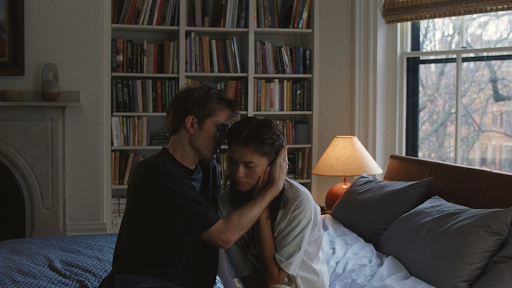
THE DRAMA was far more positively received by general audiences than expected. A “B” Cinemascore for an A24 black comedy about the American gun violence epidemic is nothing short of remarkable. However, it wasn’t just that people were enjoying the movie. The nightmare discourse that early reviewers were fantasizing about ended up being anything but. People were actually having positive and productive conversations about THE DRAMA’s provocative themes and complex characters. Most notably, every fan of the film rallied around hatred of Haim’s Rachel. This character is so deeply judgemental and performative despite her confessed transgression—locking a mentally disabled childhood neighbor inside of a mobile home closet because he annoyed her—being far worse than Emma’s unrealized homicidal thoughts. Using her cousin’s paralyzation at the hands of an actual mass shooter as fuel, Rachel relentlessly shames and torments Emma, even to the point of delivering a thinly veiled evisceration of her character during her wedding toast. Discussions around the film chastised her and approached Emma with an uncharacteristic level of empathy. It became clear that regardless of my vendetta against Borgli, THE DRAMA was here to stay.
I stewed in my rage and bitterness a couple of days longer. Then, that Tuesday, Donald Trump threatened to annihilate all of Iranian civilization with a strongly implied use of nuclear weapons. Had he acted upon this impulse by his 5 PM PST deadline, the world order would’ve been thrown into irreparable ruin that thankfully remains conceptual, at least for now. When the workday ended and armageddon had been averted, a strange inner peace came over me. Clearly, there are things in the world far more existentially threatening than people enjoying a movie with an unsavory director enabled by appalling age of consent laws in his home country. At 9:30 that evening, I decided to stop torturing myself and finally see THE DRAMA.
I enjoyed it. It poses a brilliant moral quandary that unfolds into a middling second act and a killer wedding-set climax. As expected, Zendaya and Robert Pattinson delivered remarkable performances as these thorny characters. As I sat in that theater and watched how the audience’s biases towards Emma quickly faded away as they realized that she was in fact the film’s most sane character, I came to an epiphany that I would’ve furiously lectured someone else about seven days prior. I’m glad that THE DRAMA exists. Kristoffer Borgli is a predator who through the combination of inspiration and the right collaborators created a film that is an unequivocal positive force in the world.
And I hope that Borgli never works in Hollywood again. Regardless of how talented someone is, studios with seemingly endless resources have a responsibility to vet their talent and discipline them to the best of their ability. Oversights happen. I don’t blame A24 for not discovering this essay that The Hollywood Reporter scanned a physical copy of to unearth. However, it is now incumbent upon them to not allow his career to continue. This would be the expectation in any other professional environment. Yet there is a great deal to pull from the success of THE DRAMA. In the wake of a cultural overdose of moralistic scolding that led to years of homogenized drek with nothing to say, people now want to engage with more challenging material. They want to laugh at the uncomfortable aspects of modern life that have turned us all into such broken, despair-ridden recluses. The pursuit of such collective cathartic experiences is why Gen Z is now the primary filmgoing demographic. In the process of sourcing and creating such stories, we won’t always get it right. For every five brilliant and well-adjusted filmmakers with original ideas, we’ll encounter one who has a past similar to Borgli’s.
I need to stop expecting myself to be completely morally pure in my media consumption. It’s not healthy to have an inner Rachel in my brain. Instead, I’ve decided to create a new social contract: Merge the art with the artist. THE DRAMA is the work of a man desperate to understand a world that would shun and shame him should his profile rise and his past become common knowledge. It’s a worthwhile and messy work because, through trying to console himself, he created a character far more empathetic and meaningful than he will ever be. This is a messy industry populated with creatives that we do not know. You or I all but certainly have favorite movies created by a Borgli-esque creep who has yet to be unmasked. When they are, all we can really do is hope that those in power hold them to even more rigid standards than those who tell others what they should and shouldn’t watch.










Comments