

 By
By Made after a decade away from music, Will Schwartz’s I WAS SHOT IN THE HEART! finds the Male Pattern songwriter still asking difficult questions. Creating a story remains at the forefront for Schwartz, who has spent that time continuing to immerse himself in writing and teaching outside of music. The new album follows a man that falls down the pipeline, yet is still in love with his wife and close to meeting the end of his life in a grocery store parking lot. The record is poignant, and at times absurd; despite some of its darkness, there is a lot of Schwartz’s trademark humor present. We chat about honing comedy in songwriting, LAW & ORDER, the new album, and more.
I know that you spent more than a decade away from music, developing your fiction, and then came back with an album that’s essentially a piece of narrative fiction in musical form. And I was wondering what it was about this particular story that made you realize it needed to be a record, or that that’s something you wanted to do in terms of the form.
Will Schwartz: Everything I’ve ever made has been narrative. I’m kind of a freak for fiction and novels. I’ve always loved story songs and country music and songwriting from that tradition. So to me, it wasn’t like I had this story in my head and I wanted to figure out if I would tell it as a novel or as a set of songs. I just started writing songs. I had this idea for a song about somebody watching TV, and the entire song would be told through the details of the television shows they watch. That way, you don’t know anything directly about the character, but indirectly knowing that they love LAW & ORDER or westerns speaks to a kind of desire that they have in them—that they want action, morality, structure, or to be a hero, something that must also be lacking from their lives. I’ve always liked narratives that are told through documents like that, that make us wonder about the people.
I always had this idea because I love LAW & ORDER and the plots and how silly they are. I just started writing a verse about an episode—it was the idea of a song about a guy who watches TV. From there, I was, like, what else does this guy who loves westerns and LAW & ORDER, who is empty, yearning, and kind of dying, care about? The next song that came was “I’m a Soldier,” which is out now on Spotify and elsewhere. It was like he’s right-wing, divorced, an asshole, and driven by grievance. It suddenly started to develop. I thought the songs were funny and worked. From there, it was already being made, and I wanted to see it through to where he ended up. He ends up in a shootout with cops at a White Plains Stop & Shop. That’s where I put him in the end.
All my things start in a notebook with observations, and then they might end up as songs or fiction. It really depends. I just follow the work where it takes me.
What intrigues me is your insightful observation that the media people consume often reflects their true selves. I was wondering where that interest really started for you. I know you were discussing Law & Order’s structure, but how important was it to you to reflect the right-wing pipeline in the media?
WS: There are two questions there, and I think they’re both really interesting. The media we consume can reflect us, but it can also not reflect us or reflect us in weird ways. I’m a big lefty, and I love LAW & ORDER and that style of drama. I have nothing nice to say about the carceral system, but I find it to be a great staging for morality problems, over-the-top plots, and outrageous characters. It can work great to house those things. I’ve always tuned in, so I’m open to the idea that what we consume reflects us, but maybe in surprising or unexpected ways.
In the song I was writing, I wanted to privilege the narrator’s perspective. The chorus is, “I’m dying to see it again / I’m dying to see it.” I spend my life trying to be busy, but my vice is marijuana, overeating, and television. Those are my vices. I do them together and can spend way too much time in front of a television screen. In my darker days, that feels a bit like dying, slowly dying; that’s the vice there. I wanted to capture that feeling.
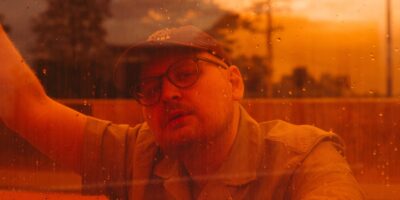
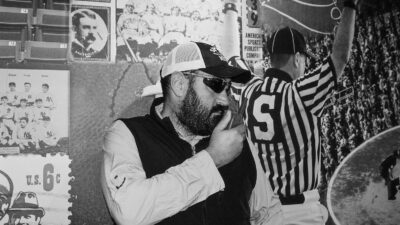
As far as right-wing politics go as it relates to media, I actually wanted my guy to be unplaceably right-wing. I wanted him to be a little bit idiosyncratic. He’s definitely driven by grievance, pettiness, small-mindedness, his own sense of being wronged, and imagined enemies everywhere. He’s desperate for validation. These are all things that drive right-wing people and the right-wing psyche. But if you notice, instead of a MAGA hat, he wears a hat that says “Support Live Music.” He’s kind of lost. My friend Andrew, who does the photos, and I developed him as being 10 or 15 years behind in the culture war. He’s got Bill Maher moments and AM radio moments. We wanted to give him an individuality because ultimately, in reality, there is a vast right-wing media ecosystem that produces brainwashed people at an incredibly large scale. Largely, those aren’t the most interesting people to write about. If it’s too dead on the nose, it’s not as interesting—you’d like to have an examined life at the center of your piece.
The main character of this record is self-pitying, hypocritical, and angry, which makes him intentionally difficult to like. I was wondering what it was like for you to spend more time in his head as a character, and if anything even surprised you over time about who he was and what you wanted to say through him?
WS: I like hard, unpleasant characters in the fiction I read. I’m very comfortable with that. It’s more fun to spend time with a baddie than a goody. I love the movie SCARFACE; everyone has that same thrill when they see it, but I also think it’s a smart movie about US foreign policy. Ultimately, being able to root for an incredibly bad guy on an obvious path of self-destruction is really fun to me.
I think the death drive is interesting and fun, that we are self-destructive creatures, that we hurtle towards our own death, pursue excess, and work against our self-interest regularly. That’s intrinsic to being human to me. If anything, that’s what my guy is to me. I don’t really think in terms of likable or unlikable, but I liked following how reckless, violent, and self-destructive he was. There’s a release in writing someone like that because my own vices are just TV and food. In my fiction, I like to explore characters that take darker turns, and I like reading books that feature characters like that.
You’ve described these songs as deliberately ugly, weird, and un-workshopped compared to the fiction you were writing within academics. I was wondering if doing it through music gave you a sort of freedom separate from being a novelist?
WS: The workshop model of writing education is something I’m thankful for and like very much, especially at certain points in a young writer or artist’s career. Being acutely aware of the rhetoric of your art—how other people will interpret it, interface with it, and feel about it—is an important thing to know. Without that, your work can be kind of impenetrable. I’ve benefited from workshops in terms of knowing that things that really hit for me don’t hit for other people. Understanding people as readers has been good.
I saw Garth Greenwell speak, and he said something like, “The workshop model is inherently flawed because it trains you to please a set of readers.” I think that’s true. It makes the process of making art cloying and desperate for approval so that it fits the guidelines of the group you’re working in and makes them happy. You lose sight of how exciting it is to write something very personal and dangerous. While there are people like Paul McCartney who write profound work and are massively popular, that’s rare. When I think about artists I love, like Lou Reed or James Ellroy, they alienate lots of people. Lou Reed is an ugly writer and makes nasty music; James Ellroy writes very violent, bleak work with a dim view of civilization. It’s not for everyone, and that’s good. If you make something designed to be universally appreciated, it won’t have an edge.
When I was getting my MFA, I wrote a novel, workshopped it, and finished it. It took me years, but I realized I wrote it based on what I thought people would like, which killed the work. It was OK, but it wasn’t really mine and had no urgency, so I shelved it. I started working on another novel, the one I’m working on now, and started working on these songs as well. It’s been liberating to get in touch with the sense that not everyone is going to like what I do, and that’s OK.
In your work, you have a balance between comedy and horrific moments. How do you strike that balance between what needs to be funny and what needs to be serious, and how does comedy or the joke lend to talking about these bleak topics?
WS: Joan Rivers was once criticized for joking about the Holocaust, and she said, “What else are you going to joke about?” That’s the way I feel; that’s the best stuff to joke about. My humor veers dark, but I like mining the tragic for comedy with the right distance, irony, and positioning. The comedic and tragic modes of storytelling are very similar; they follow similar arcs of expectation, disappointment, and loss.
Watching Buster Keaton fall down is the most basic, universal form of comedy, but fundamentally it’s mean. Laughing often comes from things where we feel ashamed to express amusement or feel nervous or taboo. It becomes a way to work through complicated, repressed feelings. They live in the same wheelhouse. Thinking of the comedy of Tim Robinson in I THINK YOU SHOULD LEAVE or Tim Heidecker’s work, there’s something really pathetic and miserable about their characters, which makes it funnier. Great tragedy also needs a touch of humor to make it lifelike and real, like in Fargo, where the humor of the dialogue rescues it from a singularly morose effect.
A lot of the album seems interested in the stories that people tell themselves to make their own lives feel larger or more meaningful. Do you think storytelling helps us understand ourselves, or can it easily become a way of avoiding responsibility?
WS: Both are true. We tell stories to lie to ourselves. We are meaning-making beings, and to make meaning, we put the world into a logical structure where things matter. This isn’t true in nature; it’s only true to us. Our experience is encoded as narrative.
Even broad ideas, like the notion that history bends towards justice or progress, stem from narrative structures like Christian eschatology, the belief that everything ends in peace and our losses are absolved. These are just stories. History bends towards progress at times, but humanity also founders or regresses. Even hardcore materialists who believe every biological feature tells a neat evolutionary story display our human bias to render the meaningless meaningful. Narrative is how we do that. Whether it leads to truth or falsehood, it leads us to create interesting knowledge.
Was it important to you that the record didn’t tell us exactly how we’re supposed to feel about this person?
WS: I don’t want to pursue moralism in my art or make a moral point about people. I like art that suspends morality. David Lynch talked about being ordinary in your life so you can be adventurous in your art. I’m a value-driven person in life, but I like suspending that in my art so it lives without those constraints.
I don’t want to tell anyone how to feel, but there are personal ballads on the record, like “There Are Angels,” which is about his divorce. It’s told from the point of view of a narcissist, but he’s hurting, and I want that hurt to come through. Songs as a form have an incredible ability to capture mood and feeling. Listening to an Elliott Smith song evokes a specific feeling and comfort. I didn’t want to lose that or make the record just a laugh. It was important to have moments of emotionalism and mood so it isn’t just, “Look at this stupid piece of shit before he dies.” He has rich, human feelings, even if he’s a flawed, shitty person.
The story eventually ends with this man having a shootout with the cops at a Stop & Shop in White Plains. That’s such a mundane setting for something so big to happen. What drew you to that collision?
WS: In the movie ADAPTATION, a character asks how to write a story where nothing happens, just like real life, and the script doctor dresses him down by saying real life is full of murder, pain, love, and loss. I like stories that feel real and like they could happen. White Plains is the everycity to me; it looks like a thousand suburban downtowns across the country with a shopping mall, big box stores, and suburban houses.
We’ve all been to a Stop & Shop. Tony Montana’s mansion at the end of SCARFACE is great, but we’ve never been there. Seeing a guy handing out frozen meatballs in a quiet, all-night suburban grocery store is much more evocative than something grandiose. You can mine mundane settings for detail, familiarity, and life, making high drama in low places feel counterintuitive and impactful.
Even though there’s an overarching story at play, each individual song also stands on its own. How did you approach making the songs their own piece while holding the larger narrative together?
WS: When I started, I didn’t know I was writing a concept record. I wrote one song about watching TV and another making fun of an online right-wing perpetual victim. Edgar Allan Poe talked about the “unity of effect” in short stories, that a story has enough space to nail down one mood, and everything should contribute to it. I feel that way about songs. If I needed a song establishing him becoming addicted to pills and losing his job for the narrative, I focused on making that individual song as good and complete as possible, without depending on references to other songs. Each song was its own world.
What was the most emotionally fulfilling aspect of working on and releasing this record, and did it teach you anything about your artistry?
WS: I love making my friends laugh. Telling jokes and funny stories makes me happy. Writing this made me realize how important laughter is to my work. In the past, I made projects that were overwrought or overly serious, and without humor, they lacked life. The thing I enjoyed most was sending these songs to close friends and collaborators, playing them live, and hearing them laugh. That was the best.
As for my artistry, for many years I eschewed meanness in my work because I thought a writer had to feel precious about their characters. I felt a great sense of liberation realizing that isn’t true for me; I can make fun of people and be a bit of a jerk as a writer. Those modes are very rewarding for me.
Is this character pattern something you want to keep developing, or did this album scratch the itch for you to focus back on novels?
WS: I’ve pinned down all the vocal and guitar tracks for a new record, so the songwriting and tracking are done. I hope it will be out next summer. My wife and I are also having our third baby in the fall, so I have to temper my expectations, but I realize I want to make art, write songs, and write novels for the rest of my life, regardless of audience size. There’s a great sense of liberation in that.
You can check out I WAS SHOT IN THE HEART! over on Bandcamp! Header Photo Credit to Andrew Piccone








Comments