

 By
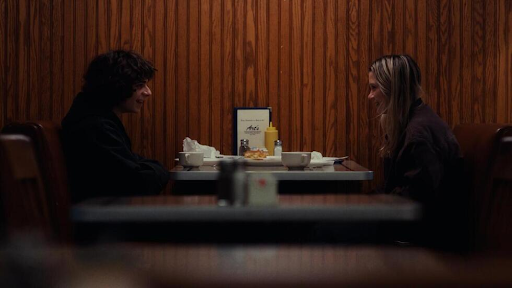
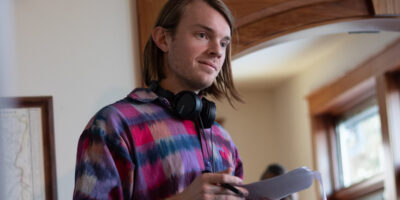
By In the short film ONE NIGHT, we witness a connection in a diner, but it sparks into much more than that for Margaret (Rain Spencer), who goes back to Will’s (Jackson Reid Kelly) apartment. As the night unfolds, so do revelations about navigating romantic love for the first time and the desperate search for connection that comes with navigating your early 20s. To more deeply understand the inspiration behind the film and what it’s been like to debut a short at the Tribeca Film Festival, I sat down with brother-sister duo Maggie and Tyler Brown to talk about the creative process on their first short film.
This interview has been edited for length and clarity.
Tribeca describes ONE NIGHT as capturing the “fleeting magic” of first connection. What made you want to explore a relationship that’s so impermanent, especially for somebody in their early adulthood?
Maggie Brown: I graduated from Columbia [University] last week, and I think so much of my experience when I was there was these experiences where it almost feels like you’re speed-dating someone, whether that’s in a friend capacity or in a romantic capacity. And it can be so hard to find an authentic connection when you’re in your late teens or early 20s and you’re away from home in a new place, and all you want is to just meet someone, and for it to work, and for you both to just get each other. I had a couple experiences like that where you have that night and you stay up all night talking, and if you’re a hopeless romantic like me, you’re like, “Maybe this is the one.” You hear all those stories about how people meet someone in college, and maybe I’m meeting someone in college. So, I think I was talking to Tyler about this idea and a couple experiences that had happened to me that were sort of along the lines of [ONE NIGHT], and then I found out that he had had very similar experiences as well.
Tyler Brown: When we were talking about this, we didn’t realize pre-Tribeca that this was an experience that we both had separately over the course of five or six years. The same thing that happened to Rain happened to both of us in the film. Once we got to Tribeca, we had so many people coming and talking to us, and we just realized these are not unique experiences whatsoever, and that these are experiences that so many young people go through just in the hopes of trying to meet “the one” or have that first connection, and kind of how it worked for me and Maggie, this was both. We drew these experiences from before either of us ever had a serious relationship. I feel like before you have that experience with a serious relationship, you don’t really know what to expect or know what is right and what it actually looks like.
At what point did you know you wanted to tell this story through a scripted project? What led you to a short over a feature-length project?
MB: I was working for a French family as an au pair, and I was living in a bedroom in their house and taking care of their kids. I deleted all social media because I was like, “I just want to be fully present.” When I was doing that, I suddenly got all of this creativity back again and started drawing and storyboarding. I just sort of journaled out this story partially based on a true experience and partially based on a composite of multiple experiences. I drew this out, and I texted Tyler, and I sent him these photos, and he ended up telling me about his experience.
TB: It really just turned into a short film because Maggie sent over these beautifully detailed stills that she had drawn.
MB: I mean, the whole thing came together pretty fast, in essentially a month.
TB: We’ve worked on tons of our friend’s short films for the last six-to-eight years, and we really just observed and helped in different roles. We were just, like, “This is our time now.” We have to try, and I think we just had—at least I personally just had—such a fear of failure and how I was going to be perceived by all of my peers if I made something that’s not what they deemed to be cool.
MB: You definitely have to get over that fear. Tyler and I for years—six-to-eight years—have been PA-ing for free, producing for free, doing all of these things for free for our friends, which we love because we just love being on set. So, we’re always down to volunteer for free, and when it came time for us to do our short, we had written the script and we were starting to take it to our friends that we had done all these favors for hoping that maybe they would do favors for us. We were so scared because we were like, “What if they don’t like it?” And then luckily our friends were so supportive. That was really special.
TB: Our short is such a romance drama and all of our other friends’ shorts that we’ve worked on for years have never touched on this subject matter whatsoever; they’ve all been, like, super high concepts. This was just, like, completely 180 from everything all of our other friends have worked on.
MB: We are hoping to ultimately make a feature. We decided obviously a feature is incredibly expensive and a big production; we need experience first. So we thought, okay, well, maybe if we can pull off a short film and we can have—
TB: A director, writer, and proof of concept.
MB: Yeah, just for our body of work to speak to us and for us to be able to show it to other people to vouch for our work. Then maybe down the line, someone would want to give us money.
You mentioned that feeling of clicking with somebody and vibing with everything they’re saying. What was it like balancing that in the dialogue?
TB: Maggie and I just have really flowing conversations in general, just as siblings. We’ve been best friends our entire lives. So, this is pretty much just real dialogue that we randomly just get into. Personally, I love SURF’S UP. One day, we randomly got into a debate about the greatest animated movies. I was like, “SURF’S UP is just downright the greatest animated movie of all time.” And in my opinion, it is a perfect movie. So we were just like, “Why are we not just using our random daily life conversations that we have with each other?” We really tried to model the diner flow off of Gilmore Girls and how their dialogue and their dynamic are so back and forth; you just fall in love with those characters. We wanted to replicate some of that where it’s just fast, witty dialogue, but you also really get to know each of them.
MB: When we first put together an assembly [cut]—and then later did the first and second draft—it felt so long.
TB: It’s tough when you shoot something; you fall in love with every single shot, and you want to keep using those same shots over and over again. It was tough, we spent at least two or three weeks just on [the] diner scene to get it right because it went so slow. We started thinking, “Oh my God, did we just make a horrible short film?”
MB: There’s that famous quote, which is that your film will never be as bad as your first assembly or as good as your dailies. For us, every single shot looked so beautiful. But then it was about realizing for the first time, because this was the first thing we’ve ever made together, that we’re actually shaping the movie in the edit too. So it was like, “Wow, we actually have the power to make this movie whatever it is that we want it to be.” There’s no template. I think that’s so scary, but so exciting. You actually get to create something from scratch, and you’re the one building it, and you’re the one deciding that, but it’s also terrifying because it’s all on you. If it doesn’t come together, then you just have to make it come together.
Even though it sounds like you’ve been on a lot of sets together, what was it like bringing your collaborative energy together to make this, and how did it feel?
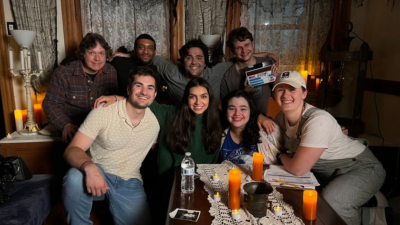
MB: I think Tyler and I have—and I feel like a lot of siblings have this—sort of the sibling telepathy thing where, you know, you’re in a social gathering and you sort of look at each other, and you’re both thinking the same thing, and you know it, and you don’t have to address it. That dynamic carried over onto set, which was really shocking. We didn’t know this was going to happen. We didn’t know that we were going to work together so well. So it was definitely a risk. We shot at our former babysitter’s apartment; she let us use her apartment for free for two days, which is so nice. We took turns going into the kitchen and tapping our DP on the shoulder as he was here with the camera, and we were behind him, tapping him when to turn for pacing. The crazy thing is we didn’t even discuss it, but it always lined up like it was the same.
We have the same references because we watched a lot of the same movies growing up, and we have similar lived experiences. In some ways, we understand each other better than any other friends really could because we grew up together. We only had one small argument, and it was when I and our friend Ava did the set decoration; we built that entire bedroom. They let us somehow use their spare bedroom. So we put up these posters. And I got a little too carried away. As a director, you’re supposed to be setting the tone for how everyone’s working and you’re supposed to be leading everyone. But Cher came on, and then we were singing “Believe.” Tyler walked in, and he was like, “Sidebar, you have to stop playing Cher. We have to get back to work.”
TB: We were on a super, super, super tight schedule.
MB: And I was dancing to Cher, then the entire crew started dancing, and everyone was doing karaoke, and it was like, we’re losing, we’re losing the light. So we have to go.
Were there any unexpected things that came together in the moment?
TB: It was just last-minute, the push on Rain in the diner that almost did not happen at all. And that’s just one take with our amazing key grip gaffer, Peter, who was like, “We need this dolly.” Kuba was also like, “We need this dolly,” and they made it happen. We had our amazing team pulling tables and laying dolly track; it was insane. I ended up going to Chapman Dolly and picking up that dolly maybe three hours before we started that day, and a U-Haul that I literally just rented and brought the dolly to Art’s Deli and set it up, and we were like, “This was the right shot all along.” I’m just so happy that we spent that extra $300 on a dolly.
MB: I remember at the moment Tyler pulled me aside, and he was like, “We’re going to have to spend 300 more dollars.” I was like, “Hell no, we’re not spending 300 more dollars.” And then he was like, “No, I really think it’s important. It’s going to make a big difference.” I’m really glad that I listened to him, and we’re still out that $300, but I’m happy that we did it.
What made Rain Spencer and Jackson Reid Kelly the right choices for these characters, and what was it like working with them?
MB: We didn’t know either of them before working on this project. We had written the script, shown it to our DP and our producers, and kind of assembled a team. We knew that we were doing it for a super-micro low budget. So we had never imagined that two experienced cast members like them would want to be a part of this project.
We sent the script to our friend, Kai Caster, who we went to elementary school with, and he was like, “I know this guy, his name is Jackson. He’s very down to do projects; he’s a really talented actor, and he just shot this show called THE PITT.” He was like, “It’s coming out soon.” That was before THE PITT had come out. We met with him at the same diner that we shot at. He came in and sat down; the second he walked in, it was like, “Man, this guy—we need him to do it. Now we’re attached, and he has to do it. We’ve got to seal the deal.” And unfortunately, we’re going to have to ask him to do it for free because we don’t have a budget. He agreed to do it for free, and he got so involved that he let us use his furniture for his home. He let us use his closet. We went over to his apartment with all his little knickknacks for everything; he literally let us take the art off his walls, the clothes off his back, everything. We still didn’t have Margaret cast yet. Jackson sent us a list of eight or nine female actresses that he had taken classes with or met over the years. We saw Rain, and we were like, “This girl’s got it.” We met with her at the same diner again a couple weeks later; she walks in, and we’re like, “Well, shit, like, now we’re attached to her too and we need her to do it” the second we met her; we still talk about this because since working on this project, Jackson and Rain have become two of our closest friends.
We just had this feeling not just that we were going to make a short together and it was going to be really fun and amazing, but also that they were going to become a part of our family. She and Jackson happened to have the same three days free, and our DP didn’t get asked to shoot anything. He was like, “I’m so sorry, guys. If I get asked to shoot something where I’m going to get paid my rate, I have to say yes,” and luckily no one got asked to do anything where they were going to be paid, and everyone was down to volunteer. It was really like fate that that happened. I just, I can’t believe it.
Did working on this short film make you discover something that maybe you want to dig in to in future projects together?
TB: Margaret’s character is something that we really want to dive deeper into on the feature that we just finished a draft on. The short was—I don’t know if it started out as a proof of concept for the Margaret character, but it kind of turned into one.
MB: It was originally supposed to be a proof of concept for a television show based on the experience of being a college student.
What has it meant to you to be able to premiere the short film at Tribeca?
TB: It’s literally been like a dream come true. We worked so hard on this project, and our crew worked so hard. We applied to tons and tons of festivals. Tribeca was always the dream festival I thought would never happen. It was mind-blowing when we found out. For me at least, besides the initial shock of finding out, it didn’t feel real until we actually got here and experienced it, and we just got to meet so many amazing filmmakers that are in our block and the amazing programming team of Ben Thompson. He is a genius and such an amazing person. He is the lead programmer for the shorts section and assembled these amazing different short blocks.
MB: Our short block was amazing. It was all love stories. It was called “Love Fictionally.” When we first found out, I believe that Ben Thompson was one of the few short programmers, maybe the only one, who still called people on the phone to tell them that they got in. And we got an email from Ben, and it was like, “Hey, are you around today to speak on the phone?” We were like, “Oh my God, either something really good is about to happen or something really bad is about to happen.” We got on the phone with him, and he started saying all these things he loved about the short and how the story felt so relatable. And he was like, “I just want to let you guys know that we’d love to have you at Tribeca.” And I was holding back tears. Our story takes place at a fictionalized version of Columbia [University], which is in New York. Tribeca is a festival in New York. And all of our friends that live in New York were able to come. Professors were able to come, which was really cool. It was just special to have a place to premiere that also feels a little bit like home as well.
Is there a moment for you during this whole experience, from production to post-production, that reminded you why this story needed to be told by both of you?
MB: When we were shooting it, it felt like even our crew members had experienced this [movie’s storyline]. And I think it just is something that—I don’t know whether it’s that it can feel embarrassing or sad or heartbreaking, but, like, this moment is something that is relatable, but it can make you question whether or not there was even a connection there in the first place. So really just focusing on telling people that no, this does happen. Whether or not they tell you they have a girlfriend, it doesn’t mean that there wasn’t that connection. It doesn’t mean that you’re crazy and it’s not real. Maybe you’re a hopeless romantic and you project things onto the situation, but no, like, if you have a connection with someone, you have a connection with someone. Part of being young is learning how to handle your feelings for people for the first time. I think hearing from people that this story happened, like, every step of the way, you know, that was exciting. Everyone said that: It felt relatable. So I felt happy, or just sad, about that.
You can keep updated on ONE NIGHT over on Instagram, @onenightshortfilm.


Comments