

 By
By Paul Greengrass has a singular talent for capturing the minutiae of a crisis. His docu-dramas CAPTAIN PHILLIPS, UNITED 93, and THE LOST BUS meticulously introduce and humanize working-class characters who will face a life-or-death test of their professionalism and will to survive. There may be a movie star or two at the center of the story, but we never lose sight of the collective. THE UPRISING, which chronicles the English Peasants’ revolt of 1381, poses a fascinating challenge to Greengrass’ framework. This time, the calamity in question is not carried out by an easily vilified group like pirates or hijackers. The working class people are the ones disrupting the social order and we cannot root for the royals to problem-solve their way out of this reckoning. He also cannot cast any actual 14th century peasants or paupers in supporting roles for authenticity. Rousing, old-school cinematic drama must prevail. Sadly, it does not. THE UPRISING certainly isn’t an incompetent film, just a generic one. Instead of finding a way to adapt his flourishes to suit a new genre, Greengrass delivers a sterile re-enactment of this conflict primarily driven by the violence within it.
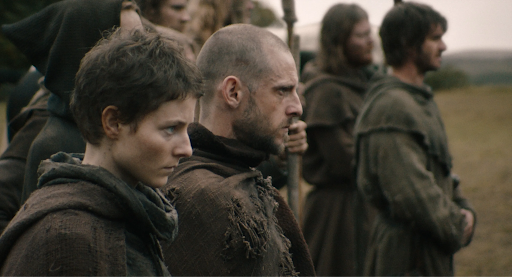
We’re dropped into a long-suffering England as some context-setting intertitles taunt the Ploughman (Andrew Garfield) as he toils over the farm where his family died. Within minutes, he decides to incite a revolution that will change the course of history. The lackeys of adolescent King Richard II (C’MON C’MON’s Woody Norman) invade his small village to impose even steeper taxes and torment any woman walking by. When one of them pesters the Ploughman about paying his family’s “death tax,” he becomes enraged and publicly attacks the enforcers as his fellow citizens join in. Word soon spreads of this insubordination and it becomes a national movement. The Ploughman becomes a figurehead alongside preacher John Ball (Jamie Bell) and Wat Tyler (Cosmo Jarvis), a former friend of Richard II’s deceased father. They hope that Richard will hear their pleas once they dispose of his sniveling council who have championed these horrible, exploitative laws.
The audience’s righteous anger towards elites in power is taken for granted. I have to wonder if an entire first act got sent to the cutting room floor. We do not get to ruminate in this miserable world at all. Ideally, we’d spend some time with the Ploughman as he witnesses injustices carried out against his people, a few scenarios that could make the enemy daunting enough to make resistance seem hopeless. Greengrass is clearly trying to toy with modern anxieties about fascism. However, even in a world with access to technology, the common person still feels as though there is nothing they can do. A cop on the street would kill them if they act alone. The army and their drones and robot dogs would kill the collective. Spending time to show us how that feeling transcends time and technology would’ve done wonders for THE UPRISING’s sense of tension and catharsis. Instead, we are off and running immediately, too busy shuffling through the motivations of our large cast and whatever battle they are facing next to really feel like we are there along with them.
Andrew Garfield is a tremendously versatile actor who finds himself adrift here. The Ploughman’s only truly impactful moment is his initial moment of fierce defiance. Garfield is rousing in this sequence that probably should’ve led to a violent, but heroic, end for this character. Instead, we’re supposed to believe that an entire movement with no way to communicate beyond oration would universally accept this random man as a figurehead. He acts as an audience avatar to interact with actual historical figures Ball and Tyler, and eventually just becomes a sounding board for them to plan their next moves. Jamie Bell and Cosmo Jarvis bring a more authentic sense of grit to their turns that make Garfield look too polished by comparison. We’re watching a film full of battle-hardened men and one soft-spoken, handsome male model who sticks out like a sore thumb.
Greengrass also spends a ton of time with Richard and his council. He’s clearly fascinated by this young man who is thrust into reckoning with the sins of his ancestors. Woody Norman is compelling in his portrayal of Richard’s inner conflict. His innocent nature wants to break through the cycle of violence and find the logical solution that the parasites around him say is impossible. Eventually, power corrupts, but he’s not a total Joffrey-style snot-nosed brat. He’s certainly a more distinct character than anyone on the heroic side. Perhaps Greengrass’ most potent way into this story might’ve been to place us in Richard’s POV from the start, even if the optics of that would’ve been a hard sell. Might as well, it’s not like “The Rise of Robin Hood” was working wonders. The marketing department has done THE UPRISING a tremendous disservice by invoking that iconic legend. While the Ploughman’s arc certainly has shades of Robin Hood, the film makes no overt attempts to link the two.
The vast majority of the action here are standard medieval battle sequences with crowds of people slicing each other with swords. Bows and arrows only occasionally come into the picture. Greengrass’ signature handheld photography is disastrous in these chaotic scenarios. There are simply too many people on screen to track any sort of motion via the shaking. It doesn’t turn the Ploughman into a formidable Jason Bourne of sickle-wielders. It just makes all of the action choreography look inept. Boilerplate photography of a renaissance faire is genuinely more immersive.
Perhaps it was wishful thinking to expect a Comcast subsidiary to produce a genuinely inspiring revolutionary piece. After all, their stocks might drop if such a thing were to lead to any action. Instead, THE UPRISING is perfectly satisfied with making such acts feel like fodder from a historical film. Rather than a landmark film in Greengrass’ career, or even an Oscar contender, THE UPRISING exposes the director as a one-trick pony, best suited to his usual cinematic ambulance-chasing.











Comments