

 By
By Two years ago, a few days after the holidays, I was standing at my desk, barely into my morning tea, while Microsoft Teams notifications pinged at me like a death rattle: “Are you joining the Zoom?” “Have you reviewed my edits?” Then came the calendar invite: “Performance Review.” Attached to the invite was my manager and HR. “What could possibly need to be reviewed?” I thought. I was fresh off a massive win for my biggest tech client — one so successful the company’s CEO called it one of the “top three moments of his entire career.” I had spent over a decade clawing my way into a corner office, supervising accounts, managing staff, and earning a comfortable six-figure salary. And yet I was profoundly, spectacularly miserable. I didn’t hate the work itself; I loved writing, ideation, client wins, business relationships, even the stupid annual reports. What I hated was the theater: the whispered jockeying over promotions, junior execs working 60-hour weeks for the chance to be “seen,” colleagues sabotaging one another over Slack for scraps, and as the cherry on top, receiving a press release from my own subordinate that was very obviously written by ChatGPT.
This wasn’t the first time I’d thought about ending it all. Figuratively, and maybe a little too literally for comfort. After spending over $100,000 on an undergraduate degree and a decade grinding my way up from the very bottom through long nights and soul-numbing admin work, I had finally reached the promised land: middle management. I was told this was the place where you could coast. Just deliver consistently “good” work, avoid falling on any swords, and watch the checks roll in. Instead, I learned that middle management is a scam. Permanent vigilance dressed up as stability. There was always a junior employee quietly gunning for my job, always someone above me making sure I didn’t get too close to theirs. I refreshed LinkedIn more than I’d like to admit. I reread Slack messages for tone. I watched layoffs ripple through the industry while telling myself I’d invested too much to walk away now. And yet, beneath the keyboard clatter of another pointless email update, a quieter voice kept insisting I was on the wrong path, that I was meant to do something that actually mattered, something that didn’t fill me with dread before my feet hit the floor each morning. I drowned it out the only way I knew how: more work, more productivity, more compliance. It felt too late to change course. I had no other choice.
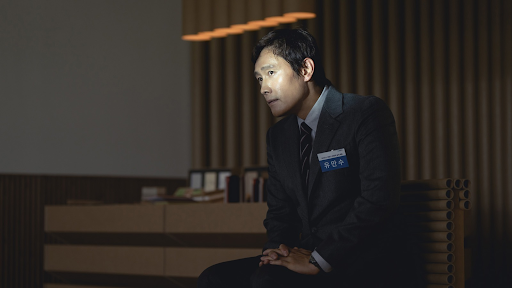
NO OTHER CHOICE couldn’t have come to me at a better time. For a filmmaker best known for exploring vengeance and moral rot in films like OLDBOY, THE HANDMAIDEN, and LADY VENGEANCE, this may be Park Chan-wook’s most seething work yet. Like much contemporary South Korean cinema, it shares DNA with films like Bong Joon-ho’s PARASITE, whose indictment of capitalist excess resonated so deeply with American audiences precisely because the anxieties it exposes are universal in a hyper-consumerist society. But unlike American tales of greed and excess (i.e. the chest-thumping, cocaine-fueled bravado of something like THE WOLF OF WALL STREET), Park isn’t interested in cartoonish caricatures of ambition. He’s fixated on something far more unsettling: the quiet horror of people who followed the rules, did everything right, and still ended up disposable.
The film centers on Yoo Man-soo, a longtime middle manager at a paper company who is abruptly laid off after 25 years of loyalty and thrust into a humiliating, soul-eroding scramble to secure another job that perfectly matches his experience and status. As his wife, Yoo Mi-ri, and their children make practical sacrifices to stay afloat, Man-soo spirals. Interviews blur into interrogations, competitors become threats, and after more than a year of rejection and quiet desperation, his search curdles into something far darker, culminating in a series of increasingly drastic decisions to eliminate his competition — literally. Not in pursuit of power, wealth, or fulfillment, but simply for the privilege of remaining exactly where he was. In Park’s hands, unemployment isn’t just an economic crisis but an existential one, exposing how thoroughly our identities, relationships, and sense of worth have been outsourced to institutions that will discard us the moment it’s convenient. I recognized myself immediately. Not in the violence, but in the fear.
The film’s message feels uncomfortably immediate amid the familiar headlines of 2025: AI accelerating job loss, corporations merging, profits soaring, and entire workforces quietly erased. In fact, NO OTHER CHOICE is so current it’s easy to forget that it’s adapted from a 1997 novel, The Ax, written by Donald E. Westlake. Aside from the murders, the real horror is how little has changed. Middle management has always been a rigged hierarchy — no ownership, no real power, no dignity — where workers aren’t trying to rise, only trying not to fall, and are therefore pitted against one another by design. If anything, the divide between corporate overlords and workers has only widened in the decades since, with job security eroding and solidarity replaced by “team player” rhetoric. Man-soo briefly entertains the idea of organizing early in the film, but the lack of support makes the outcome feel inevitable. By the end, he does as so many loyal employees do by falling in line, accepting the system as immutable, and protecting himself first. There is no collective escape here, only self-preservation masquerading as principle.
I think a lot about self-preservation. It’s the most primal human instinct we have, and yet it can differ wildly depending on what a person believes is worth protecting. In societies without meaningful safety nets, survival isn’t an exaggerated term. We’re all suspended over an abyss, clawing for whatever we can to keep from falling. Poverty, after all, is treated as a kind of social, and sometimes actual, death sentence. But for people who already “have it all,” the threat isn’t always about survival: It’s about perception. When status, stability, and identity are stripped away, self-preservation mutates into something more corrosive: pride. Park Chan-wook renders this transformation with devastating clarity in the film’s early images of Man-soo’s family home as an idyllic fantasy of light and space, blossoms raining down, purebred golden retrievers prancing about the yard. This is not just any house, it’s one Man-soo grew up in, lost, and fought to reclaim: a symbol of generational redemption and proof that he had outrun his family’s past. But once his job disappears, the illusion collapses. The house grows darker, smaller, and neglected. Leaves go unraked. Upkeep vanishes. Inside, the same decay takes hold as Man-soo’s obsessive need to preserve a lifestyle consumes him, hollowing out his marriage, his health, and his relationships. What emerges is a portrait of ancestral trauma in action, a man so terrified of losing everything again that he mistakes possession for care, and status for meaning. It was never about loving the house, or even the life inside it. It was about what the house represented. Ownership without stewardship. Pride disguised as self-preservation.
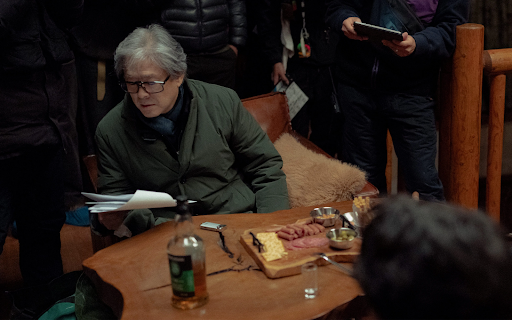
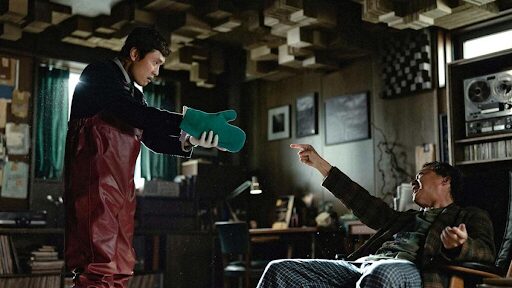
Intertwined with this obsession with self-preservation is the corrosive byproduct of toxic masculinity. In individualistic capitalist societies, men are taught to derive their worth from their ability to provide for themselves, for their families, and for the image of success they’re expected to uphold. On the flip side, sacrifice is framed as emasculation, adaptation as weakness. Throughout the film, Man-soo is repeatedly offered viable, even compassionate alternatives. His wife pragmatically cuts expenses, adjusts expectations, and takes a job as a dental hygienist, treating their situation as a temporary setback rather than a personal failure. She continues her hobbies in scaled-back ways, modeling flexibility and resilience. Man-soo, however, refuses to adapt or accept help, and that refusal curdles into resentment toward his wife, his family, and anyone who threatens his fragile sense of authority. His willingness to destroy his relationships in order to preserve his ego reveals the quiet violence at the heart of pride. The fear isn’t poverty, it’s humiliation. And Man-soo isn’t alone. His chief rival, Bummo, once celebrated at the top of his field, collapses after his own layoff into alcoholism and self-destruction, clinging just as desperately to a vision of masculinity that no longer serves him. His wife, a struggling actress, tries to keep their marriage alive, offering patience and flexibility, but his rigidity and shame ultimately push her toward a devastating end. Even the domestic spaces where these conflicts unfold reinforce the theme: homes lush with greenery, crawling with pests are symbols of life overtaken by neglect. These men are so fixated on maintaining appearances that they can no longer see what’s actually dying around them. They can’t see the forest for the trees.
Despite the film’s deep cynicism about individual agency and its suffocating sense of cyclical, systemic doom, there is one moment that cracked it open for me, a moment of unexpected tenderness that left me in tears. The family’s young daughter, coded as neurodivergent, is a gifted cello prodigy whose teacher insists she should be playing a $50,000 instrument, studying under elite instructors, and treating music as her sole path to independence and worth. Excellence, we’re told, requires investment; talent must be monetized. When the family’s financial situation deteriorates and her lessons are cut, her parents panic, not least because they’ve never actually heard her play. She practices alone, in isolation, removed even from the expectations being projected onto her. By the film’s end, it becomes clear that her gift isn’t just technical skill but an entirely different value system. She doesn’t want prestige, accolades, or expensive tools. She wants to play for her dogs. She teaches herself through YouTube, invents her own synesthetic language to understand the music in a way that works for her brain, and treats art not as status or obligation, but as play. In that moment, the film shifted for me from incisive social critique to something genuinely life-altering.
I am also a classical musician. I’ve sung classical music for over 20 years, and I have ADHD. From a young age, I was told I was gifted, encouraged to commodify my talent, handed a scholarship, and taught to see music as my identity rather than my joy. I entered college believing this was who I was supposed to be. But the rigidity of the curriculum didn’t work for my brain. I began to resent the thing I once loved. Practice rooms filled me with dread. Performing became a chore. I cried nightly during my first year, terrified that leaving music would mean disappointing my family and erasing my worth. Eventually, I took other classes. I switched majors. I became a writer, then a marketer, a path that led me to a career I would later learn to resent for similar reasons. What matters most isn’t that I pivoted once, but that I learned I could. Even in the face of sunk costs. Even when it meant dismantling and rebuilding my sense of identity. Watching the daughter create her own language for joy reminded me that survival doesn’t always mean clinging harder. Sometimes it means redefining value altogether. Like her, I had to learn to cultivate joy for its own sake, and to choose it again and again, even when the world insists there is no other choice.
That young girl validated a choice I’d already made, one I didn’t yet know how to trust. A few hours after that performance review invite hit my calendar, I sent a counter-invite to my agency and put in my two weeks’ notice before they could let me go first, a small act of self-preservation dressed up as pride. What followed was a long stretch of existential dread, the kind that creeps in when the noise finally quiets and you’re forced to hear the questions you’ve been avoiding. Eventually, I did. I admitted there was something else I wanted, something that felt aligned rather than extractive. Today, I’ve just finished my first quarter of graduate school in psychology, on a path toward becoming a therapist for other burned-out, neurodivergent women trying to untangle their worth from productivity and status. Unlike the men in NO OTHER CHOICE, I had to confront a harder truth: You can’t live your entire life afraid of losing what never truly belonged to you.
Driving away from the Alamo Drafthouse in San Francisco after the screening, I passed a familiar stretch of the city plastered with billboard ads for new AI software — the very products I once marketed for a living. The dread was still there, lingering at the edges, but it felt different this time. Quieter. Less personal. For the first time, it wasn’t tangled up in my identity or my survival. I felt sadness, yes, and a sober awareness of what’s coming, but also an unexpected sense of peace. Not because the system has changed, but because I finally stepped out of it.





Comments