

 By
By This review contains spoilers for SLANTED.
All of your life, there’s an ideal self shoved down your throat. There’s a certain size, shape, or insecurity that you’re taught to hate, and in the case of Joan Huang (Shirley Chen), it’s her race. Imagine you were offered a solution, one that started with a completely free incentive. After Joan is given an opportunity that feels too good to pass up, one that will, in her eyes, win her what she has always wanted, the potential cost isn’t even called into question. Amy Wang gives us one of the latest body horror pictures, SLANTED, a feature-length parable that allows for the feeling of being othered as a Chinese-American daughter to be observed under a microscope and quite literally pulled apart.
After growing up being ridiculed for cultural differences in a predominantly white hometown, Joan is mesmerized by the idea of prom and how the prom queen is loved by all of her peers. As a kid, she walked in on a prom while her father was working as a custodian at the high school, and the mystifying nature of the event never left her. SLANTED calls into question the social cruelty of fitting into the standards decided by our community, and the American systemic hierarchy as a whole. As Joan ages into the opportunity to run for prom queen—despite her best friend’s reassurance that it truly does not matter—Joan finds she still needs to scratch the itch of acceptance.
Deciding to fit a traditional beauty standard, bleaching her hair blonde, the teenaged Joan is quickly noticed and invited to hang out with the school’s popular crowd, including the influencer that everybody wants good graces with, Olivia Hammond (Amelie Zilber). Joan is quickly used for the group’s gain (having gotten them a nail salon discount for being Chinese) and is ultimately ridiculed for showing her roots—the result of self-bleaching at home in the bathroom.
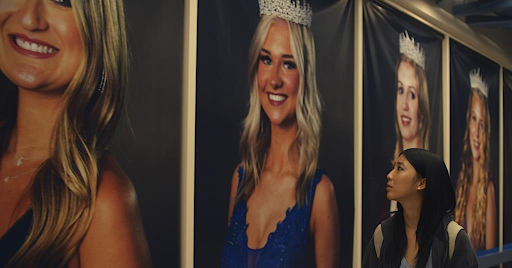
The film expands on the digital-age pressure that teenagers have felt across decades as Joan takes a filter to her face that makes her look white and blonde; it’s a quick way to modify your face that previous generations never had access to. Combine that with the pictures of women that she keeps upon her wall that fit her ideal beauty standard, and a picture is painted of how much Joan keeps herself under the microscope, being the one to prod. Given her level of obsession with this idea of what will make her perfect, it doesn’t come as a surprise when Joan is quickly swayed into having ethnic modification surgery performed upon her. What started as an innocent opportunity to have her roots touched up instead finds Joan changed forever.
Shirley Chen does an incredible job of capturing the growing pains of adolescence, especially as they follow you into the final years of high school, while beautifully capturing the duality of the love that she still carries for her parents and culture at home when no one is around to judge. Similar to the way kids don’t want affection from their parents in front of peers, Joan pulls away from the love that she so dearly craves. After Joan gets the surgery, she is then played by Mckenna Grace and becomes completely unrecognizable within her own home, now shunned by her parents who are grieving the erasure of the very culture they still consider to be at the core of their identity.
The film’s outrageous concept is unfortunately rooted in a medical truth. Two of the most common forms of the surgery include the East Asian blepharoplasty, which allows for a widening effect of the eyes, with more of the eyeball becoming visible beneath the eyelid. Otherwise referred to as double eyelid surgery, despite reports of low satisfaction, it continues to be a popular procedure done in areas including Taiwan and Japan. Many of the lower satisfaction rates, similar to those depicted in the film, include a lack of validation through social media, which Joan actively seeks. Another form of normalized ethnic surgery is a rhinoplasty to make noses smaller, increasingly popular for those with traditionally wider-set noses in Asian-African populations. The beauty standards of America and of the general Western population are wreaking havoc on the natural beauty and self-esteem of people across ethnicities and cultures, the contemporary cultural ruling class asking people to erase the things that make them who they are to fit a template of what is deemed beautiful.
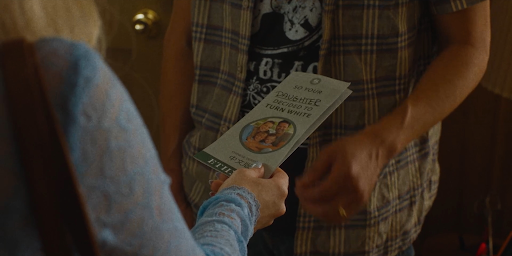
SLANTED reflects this devastating reality that is happening around us every single day across social media platforms and in our waking lives. Despite its darkness, the film also brings moments of comedy that allow for laughs you’re hesitant to let out, with moments like a theme song playing during the procedure feeling almost as ridiculous as the concept itself. The movie isn’t afraid to let your skin crawl; skin is pulled apart and held up by tape, blood and raw skin lurking beneath the surface of the clinical outlook of perfection. Amy Wang is holding a mirror to the expectations that Americans place on each other.
As Wang pulls you into her film’s darkness, she keeps you rooted in the emotional heart of finding yourself no matter what means it takes. Wang offers a commentary that shouldn’t soon be forgotten, leaving you shivering with the grisly, bittersweet image of Grace tearing her face off, exposing the Chinese features underneath all along. With proof still remaining of her birthright, we’re left to question ourselves as we wish for Chen to peel herself back further.








Comments