

 By
By I sometimes reread my own writing. It sounds self-indulgent, and it is. When writing alone cannot sate my appetite for my own thoughts, I’ll take a leisurely scroll down my Google Drive and review my greatest hits. After a handful of egotistic giggles, I’ll eventually read something that triggers an avalanche of guilt. Everyone makes mistakes, but some mistakes cannot be dismissed as casualties of craft-sharpening. These mistakes turn masturbation into self-flagellation; one such mistake convinced me that I should quit writing a few years ago. Even now, I can feel the weight of hindsight crushing my stomach as I recall my description of Al Swearengen in “Why Aren’t You Watching DEADWOOD?,” my first article for Merry-Go-Round Magazine.
Al introduces himself to the audience by throwing Trixie, one of the women he owns, into a wall. She’d shot a john dead for beating her during sex, and whores who defend themselves are bad for business. Boot on her neck, Al tells Trixie that this is her last chance: “Either way this comes out, we’ll only have to do it once. What’s it to be, Trixie?” Gasping for air, she chokes out a childlike promise: “I’ll be good.” In 2016, at the age of 21, I chose to describe Al Swearengen as “a very attractive power trip fantasy for male viewers.”
—
What could be gained by reading the person who wrote that?
Any explanation or expression of remorse I’d offer would read as a plea for exoneration. Since the monster described above warrants none, why should it be granted to me, who plainly stated their desire to embody him? Any rectifying critique I’d write would be sullied by the fact that at the big age of 21, I was unable to recognize that someone who holds women in what amounts to sexual slavery should not be praised for, as I put it, “fuck[ing] major female characters.”
I wrote that blog at a time when I identified politically as a progressive liberal feminist—a label I trumpeted to apathetic college party smoking circles and bored Tinder dates. I praised JANE THE VIRGIN, voted for Hillary Clinton, and attended my college’s production of THE VAGINA MONOLOGUES. These credentials sat holstered in my mind like six-shooters, itching to blow away anyone fool enough to doubt my allyship. Despite requiring a woman to point out misogyny for me to notice it, I felt confident that I held a Top 1000 position on the Male Feminist leaderboards. Patient partners and popular critics spoon-fed me gender-savvy insights, favors I repaid by looking down my nose at anyone who’d yet to reach these obvious conclusions. I remember rolling my eyes at a then-new post exclaiming that Tony Soprano is not an epic badass. Anyone who paid attention to the show knew that Tony is pathetic, a serial abuser lashing out at a world that no longer needs him. How could anyone think a guy like that is cool?
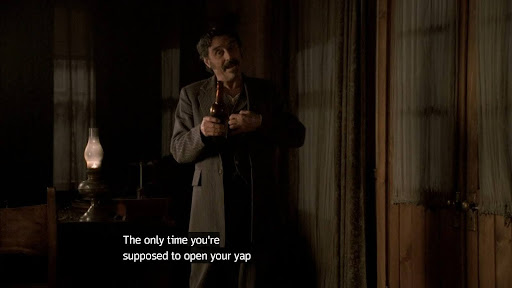
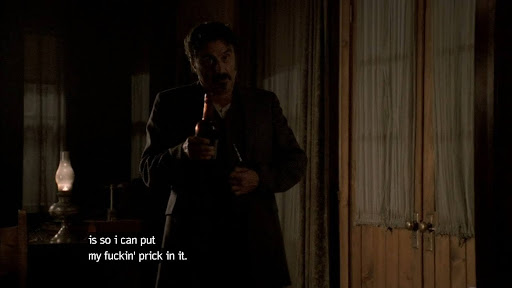
Hating women is cool as long as you speak in prose
When I first watched DEADWOOD, I never thought to myself “Al Swearengen is cool because he’s a violent pimp.” I also didn’t think “Al Swearengen is cool in spite of the fact that he’s a violent pimp.” It simply did not occur to me that Al is a violent pimp. I knew he was a pimp, I knew he was violent, and I knew that those are evil things to be. That knowledge lived separate from the part of my brain that went “HELL yeah” whenever Al blinked. Al and Tony are the same man in different eras, down to their abusive mothers and near-death experiences. But I had Emily Nussbaum to tell me Tony sucks (in a less selfish version of this article), while reviews of DEADWOOD lavish the Shakespearean dialogue and lament its untimely cancellation. Without a veteran critic to spell it out for me, I failed to recognize that Al is a violent pimp.
What was I thinking when I wrote that description? My yearly rewatch helped me remember. Al’s mocking imitation of a New York fancypants gingerly sipping at a shot of whiskey. A similar shot extended to a Pinkerton scumbag, Al’s leviathan smile hiding the knife that finds dude’s belly before the booze. Bullock’s request for a fair fistfight accepted with a growled bon mot: “I won’t need no fuckin’ knife.” None of that negates Al’s occupation, and no amount of eloquent roguishness would redeem a man like that in the real world. On television, though? In art, where people become characters and actions become symbols, should I feel remorse for liking Al Swearengen?
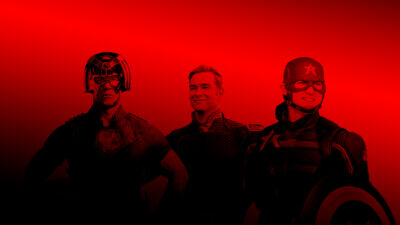
Perhaps, if only to distinguish myself from our country’s cruelest, stinkiest citizens. America’s current model of troglodyte fascist sees himself as the Punisher, Patrick Bateman, and Homelander. Swearengen shares qualities with those lesser antiheroes: If DEADWOOD aired today, Ian McShane’s mustached visage would surely become a star of their hackneyed memes and thought-destroying fancams. Twitter accounts named HearstDidNothingWrong and DeportDirtWorshippers would pay their rent by littering AOC’s replies with reaction images of Al’s bemused stares. DHS would pair videos of ICE tossing children’s bedrooms with a screengrab captioned in Impact font: “Welcome to fuckin’ ̶D̶e̶a̶d̶w̶o̶o̶d̶America! It can be combative.”
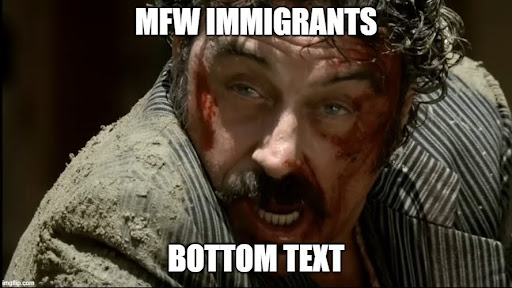
Making this my wallpaper before going to the airport
—
As larger swaths of Americans replace political action with consumption, the correlation between entertainment choices and political beliefs naturally increases. For most of my adult life, I bought into the idea that this correlation was a law of nature, and that it was my duty to inflict my morally correct taste on the ignorant masses. Like many 20-somethings of the Peak Woke era, I asserted my ethical superiority by having the correct opinions about TV shows. My idea of activism mostly involved “having important conversations about media” that were, in retrospect, pity parties at best and shit-flinging at worst. I’m not the only person who employed this rhetorical strategy, but it often felt that way when I’d attempt praxis. If someone mentioned a “bad” show, such as LAW AND ORDER, I’d deafen myself as I mentally prepared my lecture about copaganda and manufactured consent. My summaries of podcasts summarizing Marx failed to build Communism (though they did cause many people to abruptly excuse themselves to the restroom).
Rereading that blog flash-banged me with my own hypocrisy, and reminded me how blind I was to real suffering. I’m from Torrance, California, a beach-adjacent haven separated from Deadwood, South Dakota by thousands of miles and billions of dollars. The saloon closest to my childhood home does most of its business on karaoke nights and Free Hot Dog Sundays. Save for a few months in my Boston dorm, Torrance was the only place I’d ever lived when I saw Al throw Trixie.
After college, my zeal for writing gradually declined. A brief stint working in PR convinced me that I’m too soft for the jobs creatives must endure while awaiting their big break, so I took refuge in the transcription industry. Writing closed captions provided the stability and comfort that only 9-5s can, and the thrill of watching unreleased shows eased the pain of becoming Squidward. After six years, three jobs, and one pandemic-induced layoff, I threw myself into the blender of gig work hoping to jolt myself back into a creative headspace. The resulting increase in stress and decrease in money sank me deeper into depression. I stopped writing altogether. Three years of terrified inaction tore a gaping void into both my resume and my memory. I submerged myself in the amniotic fluid of self-loathing, a choice far more selfish and harmful than the bad opinions I had when I was 21.
I’m not a violent pimp—I’m not a violent anything. I once left a birthday party in tears because I broke the piñata. I sweat when I drive past Bob’s Big Boy, palms tingling as I remember shaking the eponymous mascot’s hand, the actor faux-flinching at my eight-year-old grip strength. My swollen superego loves to convince me that I’ve hurt someone, which results in anxiety, unnecessary apologies, and articles about decade-old problematic takes. I’m not Al Swearengen, and watching DEADWOOD didn’t make me more like him, but thinking it did gave me an excuse to disappear.
—
I’m glad that I reread that article, and I’m glad that it makes me cringe. No one grows up free of sin, and self-reflection precedes maturation. I forgive myself for the vanity of rereading. I forgive myself for my ignorance, arrogance, and selfishness, and for the times I let those parts of myself control my actions. But letting shame paralyze me as long as it did will be an eternal regret. I know it’s not too late, that I have plenty of years left to spend helping, loving, and writing. I also know that I could’ve had a few more. It’d be easy to blame the culture, to say that I was forced into silence by the woke mob and take the coward’s path to an unearned confidence. But personal progress starts with accepting agency, and the only one who stopped me from writing was me.
Despite knowing that it won’t save the world, I still like to talk to people about TV. When I meet a LAW AND ORDER fan, I ask them what they like about it. So far, nobody has responded with a screed extolling the virtues of real-life law enforcement. They describe falling asleep to rerun marathons, do an impression of Ice-T, and pine for a world where cops care and jails hold only the sickest of sickos. Some people, it seems, know that TV shows are fake. How someone chooses to entertain themselves doesn’t always correlate with what they think about the government, groypers notwithstanding. Moreover, liking a character does not transform one into that character. Tony Soprano is not an epic badass, but some people think he is, and most of them won’t cheat on their spouse or shoot their best friend on a boat.
Having now completed DEADWOOD six times, I’d like to take another stab at describing Al Swearengen. For all of his scheming and schmoozing, Al’s scenes with Dolly reveal his true nature. Dolly “works” for Al. One of her regular assignments is giving Al blowjobs. Combining emotional and sexual release, Al descends into drunken monologues while Dolly performs her grim duties. Camp gossip and criticisms of Dolly’s dicksucking technique veer into rambling stories from Al’s childhood. Scattered details form a Tragic Backstory—abandoned at an orphanage, dead brother, pimped out by “fat fucking Mrs. Anderson”—for a man receiving oral sex from a woman who can’t really say no. Far from exculpatory and deeper than “hurt people hurt people,” Dolly’s scenes scream Al’s quintessential question: “Can you feel bad for the worst person in the world?” For better or for worse, I do.













Comments